Alchemy on the Amstel: a visit to the Ritman Library

In September last year, I heard of the Amsterdam Ritman Library or Bibliotheca Philosophica Hermetica for the first time. I had been wanting to see the exhibition ‘Alchemy on the Amstel‘ (until 20 September 2013) ever since, and last week I finally got a chance. On a sunny afternoon I cycled to the library, hidden away in a side street of the Prinsengracht, a stone’s throw from the Westerchurch.

In stark contrast to the hustle and bustle outside, just metres away from the throngs of tourists queuing for the Anne Frank house, the Ritman Library is an oasis of silence. Founded by the Amsterdam businessman and maecenas Joost R. Ritman (1941), the library holds a unique collection of hermetic books and manuscripts with a focus on the Christian tradition. The collection covers areas as diverse as alchemy, Rosicrucian works and Gnostics, from the Middle Ages to the present day.

The current exhibitions at the Ritman Library, ‘Alchemy on the Amstel: On Hermetic Medicine in the Golden Age of the Dutch Republic’ and ‘A Curious Tsar: Peter the Great and Discovering the Secrets of Nature in Amsterdam’ (in conjunction with the exhibition ‘Peter the Great: an Inspired Tsar’ in the Amsterdam Hermitage), are small but rich. They give the visitor a quick but thorough insight in Amsterdam as a centre of trade and knowledge in the seventeenth and early eighteenth century. Concise bilingual catalogues help the visitor to put the works on display in context.

Although this is a library exhibition, there are not just manuscripts, books, and other printed works on display. In one of the display cases, a small cup and a stony clump of material with a metal-like shimmer caught my eye. They turned out to be an antimony cup and a lump of antimony (Sb2S3), a lustrous grey metalloid often found in ores together with either sulphur or mercury. This combination appealed to alchemists, as sulphur and mercury were considered the basic alchemical elements. Moreover, as antimony could cleanse the most precious metal, gold, from impurities, alchemists reasoned it could also cleanse and cure God’s most precious creature, created after his own image: man.
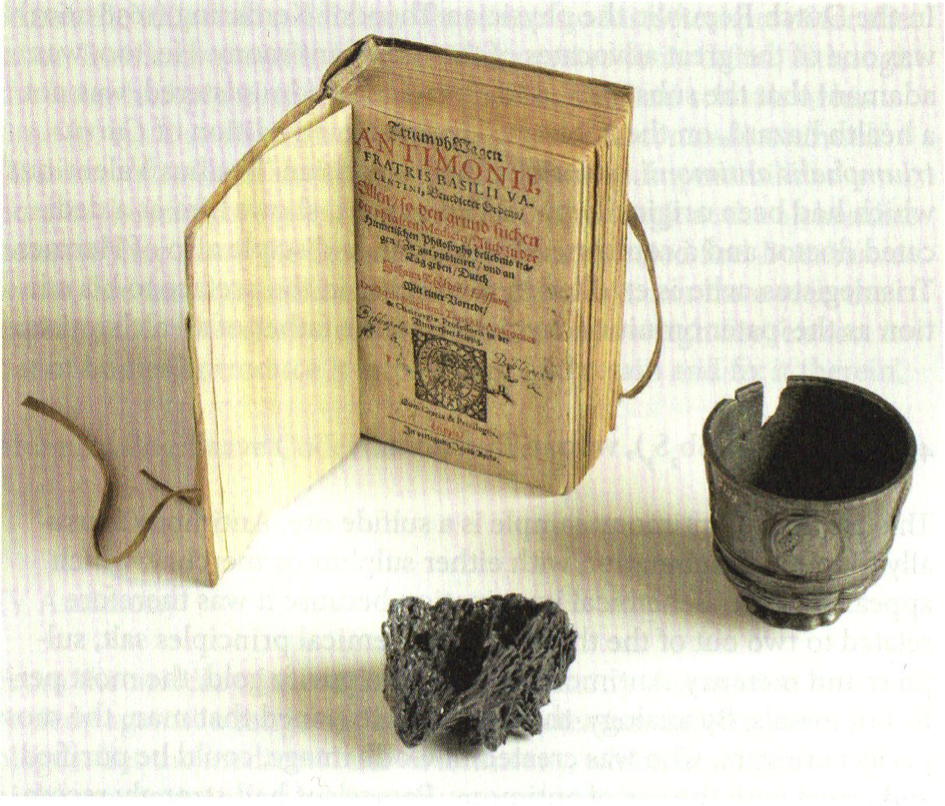
Antimony ore, antimony cup and Basilius Valentinus, Triump-Wagen Antimonii, Leipzig 1604. C. van Heertum, Alchemy on the Amstel. On Hermetic Medicine. Amsterdam: In de Pelikaan, 2012.

Antimony ore, antimony cup and Basilius Valentinus, Triump-Wagen Antimonii, Leipzig 1604. C. van Heertum, Alchemy on the Amstel. On Hermetic Medicine. Amsterdam: In de Pelikaan, 2012.

Hence Paracelsus (1493-1541) and many of his followers advocated the use of small amounts of antimony in iatrochemical drugs, although they were well aware of the fact that it is highly poisonous. Antimony cups like the seventeenth-century one on display at the Ritman library were used since antiquity to make antimonial wine by soaking regular wine in it for one or more days. This antimonial wine was a tried emetic, but antimony cups were forbidden in England and France for much of the seventeenth century as the use of a wine too acidic would result in a lethal concoction. This prohibition was sometimes circumnavigated by creating antimony cups from tin with a small amount of antimony.[1] In France antimony cups became legal once more in 1658, after Louis XIV was cured from typhoid fever with antimonial wine.[2]

The aim of this this exhibition, dispelling some of the misconceptions surrounding alchemy with a general audience, is certainly met. And for historians of alchemy and chemistry, the Ritman Library is a true treasure trove. Like many other cultural institutions, the library faced major financial challenges over the past years. All the more reason to support it by paying a visit – you will not be disappointed.
 

[1] StClair Thomson, “Antimonyall Cupps: Pocula Emetica or Calices Vomitorii”, Proc. Roy. Soc. Med., Vol. XIX, no. 9, 1925, 123-8.

[2] C. van Heertum, Alchemy on the Amstel. On Hermetic Medicine. Amsterdam: In de Pelikaan, 2012, 49.

Mercurial drops

As mentioned in previous posts, I am working on a project on mercury in eighteenth-century chemistry and medicine. Over the past few weeks, I have been researching the use of mercury as a drug in eighteenth-century Britain and the Netherlands, and I found some fascinating yet disturbing stories.

In the early eighteenth century, England was the scene of what would go down in history as the ‘Quicksilver Controversy.’ For centuries, mercury and mercury preparations had been used to cure all kinds of intestinal blockages and venereal disease. However, most physicians were well aware of the potential dangers of mercury, and prescribed it only if all else failed. Not Thomas Dover (1662-1742), alias the Quicksilver Doctor. Unlike his contemporaries, he believed crude mercury to be a cure-all for all kinds of blockages. Although he was vehemently opposed by many of his colleagues, there were enough people desperate enough to try his ‘cure.’

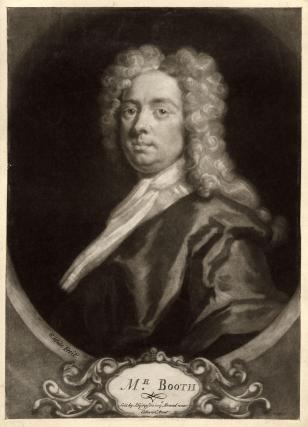
To which this could lead was shown in the case of Barton Booth (1681-1733), one of the most famous tragedy actors of his time.

Courtesy of the National Portrait Gallery D757.

Courtesy of the National Portrait Gallery D757.

From 1727, Booth was afflicted by ill health: it began with a fever lasting forty-six days, followed by returning bouts of jaundice. Desperate for a cure, Booth eventually called for Thomas Dover, who prescribed him quicksilver. Within a week, Booth ingested almost two pounds of mercury, and died. When a post-mortem examination was carried out, it was found that Booth’s intestines had turned black and were lined with crude mercury, spreading ‘a most offensive cadaverous stench.’[1]

There are no accounts of other quicksilver doctors as extreme in their views as Thomas Dover,  but popular eighteenth-century literature suggests that the Netherlands too saw quicksilver doctors. In a comedy from 1727 which has been ascribed to the Amsterdam hack writer Gysbert Tyssens (1693-1732), a ‘graduate cobbler,’ Doctor Hans, is ridiculed because he prescribes his patients mercury:

They are very good, ensuring that the sick never have to fear disease again.

Because he will cure them fast with a lethal quicksilver;

And the deceased cannot tell what was the cause of their death;

And in this way Mercury cures all illnesses.[2]

Although most physicians were extremely careful when prescribing mercury, there were clearly also men who were more interested in their own finances than in their patients’ health. Some even used their care for their patients as a pretext; a flimsy cover-up for highly profitable schemes. In the late 1750s, a small pamphlet on a new drug against venereal disease, ‘Helvetische essentie of mercuriale droppels’ (Swiss essence or mercurial drops) was printed in Dutch.

Last page of the pamphlet on the 'Helvetian essence', listing exclusive selling points.

Last page of the pamphlet on the ‘Helvetian essence’, listing exclusive selling points.

The Dutch translator Ponty, a medical doctor from Rotterdam, states in his introduction that the exact contents of the Helvetian Essence is not revealed in the pamphlet to protect patients from quacks who try to reproduce it. However, the last page suggests an entirely different reason for this secrecy: a two-ounce bottle of this miracle cure sold for 12 Dutch guilders – an amount that would equal over 100 Euros today.[3] The only selling point in the United Provinces? Ponty, the translator.[4]


[1] Kevin Dewhurst, The Quicksilver Doctor. The life and times of Thomas Dover, physician and adventurer. Bristol: John Wright & Sons Ltd, 1957, pp. 153-6, Richard M. Swiderski, Quicksilver. A History of the Use, Lore and Effects of Mercury. Jefferson, NC: McFarland and Company, Inc., 2007, pp.11-24.

[2] “Zy zyn heel goed om te maken dat een zieke nooit geen ziekte meer hoeft te vrezen. Want op een rys zal hy ze door een dood’lyk kwik altoos genezen; En de overledenen kunnen niet zeggen wat de oorzaak van hun dood is geweest; En ‘t is op die wyze dat de Mercurius alle ziektens geneest.” from: Thijsens, Gijsbert. Doctor Hans gepromoveert tot de narrekap van Esculapius, op het uilebord van Mercurius. Blyspel., 1727, p. 3. (Translation mine.)

[4] Langhans, Daniel. Gebruik van de Helvetische essentie of mercuriale droppels : tegens de venus kwalen en andere ziektens door de verdikking der ziltagtige vogten veroorzaakt. Vertaald door A. Ponty. Dordrecht: A. Blusse, 175X.

Making medicine: early modern laboratory equipment

As regular readers know, I have a weakness for the material culture of early modern science and medicine. There are scores of brilliant museums full of the stuff, but there is a downside: the most common, most intensively used objects tend not to be in museum collections. That makes sense of course: their common and utilitarian character meant they were discarded when broken, damaged, or no longer in use. Most of the spaces in which these objects were used are long gone too: they were continuously modernized, or given a new destination and transformed beyond recognition. Unfortunately, that means that in some instances, such as that of the early modern laboratory, hardly anything of a material culture remains. There are some rare exceptions, and an exciting project based at UCL studies the archaeological remains of early modern laboratories.

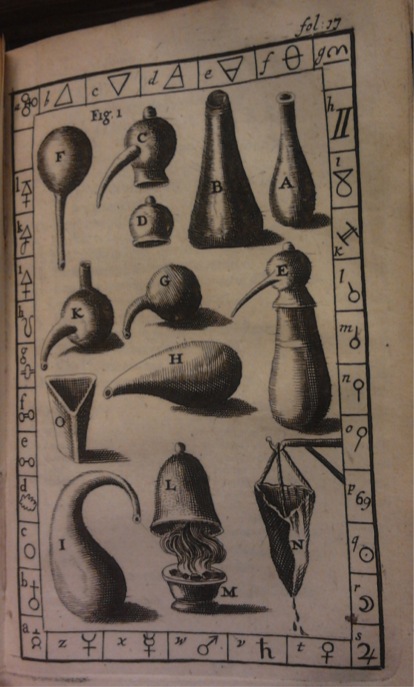
However, my current research focuses on the Low Countries, and as far as I know, no laboratory has been dug up here so far. What remains are individual flasks, bottles, jars and retorts. Fortunately, the (ideal) lay-out of early modern chemical laboratories and their inventories in the Netherlands have been mapped in print to some extent. Take for example Steven Blankaart’s 1678 De nieuwe hedendaagsche stof-scheiding ofthe chymia (The new contemporary separation of substances or chymia).

From: Steven Blankaart,  De nieuwe hedendaagsche stof-scheiding ofthe chymia (1678)

From: Steven Blankaart, De nieuwe hedendaagsche stof-scheiding ofthe chymia (1678)

Blankaart, an Amsterdam physician and natural philosopher who had started his career as an apothecaries’ apprentice, published this book based on a variety of authors and his own experiences, to advocate chemical experimentation. In it, we find not only detailed descriptions of the properties and processing of all kinds of substances, but also four plates depicting a range of laboratory equipment. Blankaart’s book, written in Dutch, was aimed primarily at professional artisans such as apothecaries, assayers, and artists who made their own pigments. This was a flourishing trade in the early modern period, as also appears from the program of this fascinating conference, which I unfortunately will not be able to attend.

By the late seventeenth century, chemistry was also slowly becoming an academic discipline. In 1669, a chemical laboratory was created at Leiden University. There are no maps or depictions of this laboratory, but it probably looked quite similar to the laboratory installed at Utrecht University in 1695.

First chemical laboratory at Utrecht University, founded 1695. From: J.C. Barchusen, Pyrosophia (Leiden, 1698).

First chemical laboratory at Utrecht University, founded 1695. From: J.C. Barchusen, Pyrosophia (Leiden, 1698).

That the laboratory in Leiden was used intensively shows from the report written by the newly appointed professor of chemistry Herman Boerhaave in 1718. He proposed to renew the ovens, as almost half a century of intense use had made them unfit, and the curators happily agreed.[1] The lists Boerhaave provided of equipment that had been ‘inherited’ from the previous chemistry professor and of equipment and supplies that had to be purchased give a good idea about the inventory of the laboratory circa 1718: iron rings, hooks, spoons, spatulas, and pliers, copper kettles, bowls and buckets, bellows, a variety of glass flasks and bottles, six brickwork ovens, wood, coal and peat, and a well-instructed laboratory assistant.[2]

To be continued!


[1] ” Vernieuwingh van de ovens, die in het Laboratorium door lang gebruyck onbekquaem sijn geworden.” From Boerhaave’s report to the Curators of the University, August 1718, in Molhuysen 1913, vol. 4, p. 150*.

[2] Ibidem, p. 150*-2*. Although the latter admittedly is not exactly an object, Latour would argue they are all actors, so why not list him as well.

Ninzin root – or an eighteenth-century placebo

In the seventeenth century, Europeans were very interested in the new plant species discovered in faraway regions. In the Netherlands in particular, the spice trade with the East Indies flourished: nutmeg, ginger, pepper and cloves were staples.  However, there were also less common plants. In the letters that the famous Dutch scholar and physician Herman Boerhaave wrote to a friend and colleague in Austria, I noticed several mentions of a root called ‘Ninzin,’ which was extremely rare and expensive. Here’s a translation of what Boerhaave wrote (unfortunately the responses of his friend Bassand were lost):

I am sorry about the enormous price of these trivia, one ounce of Ninzin root, and not even the best, has been sold for forty Dutch guilders. I would barely buy them for a trifle. That is how silly they are.[1] 

‘China root’ or ginger, from An Embassy for the East India Company, Johan Nieuhoff, 1669, p. 213.

‘China root’ or ginger, from An Embassy for the East India Company, Johan Nieuhoff, 1669, p. 213.

Apparently Bassand, Boerhaave’s friend, had asked him to buy some Ninzin root for him, but Boerhaave thought this was ridiculously priced: indeed, 40 Dutch guilders in 1718 would be about € 437.23 today![2] However, it seems Bassand was determined to get himself some of the stuff, as over four years later Boerhaave wrote to Bassand:

In all of Holland only one spice trader has the real Ninzi root, but this greedy scoundrel does not even want to give half an ounce, before he has been paid 27 guilders: so the rich are sent away empty handed. I, however, do not appreciate it more than the roots of sweet fennel, which it resembles.[3]  

In the subsequent letter, almost six months later, it turns out Bassand has sent Boerhaave 27 guilders through a mutual acquaintance, and Boerhaave has sent him half an ounce of Ninzi root in return.[4] It is not until 1728 that Boerhaave writes more about the Ninzi root and why he thinks so little of it, but when he does, it is clarifying:

The root of the Chinese Nin-Zeng or Ginzeng, or Japanese Nisi is the most important thing used by the rich for afflictions of the heart, and for afflictions of pre-hysterical and pre-epileptic nature; in Asia, China, Japan and Tartary it is so highly esteemed, that its users are promised a long, fertile, and healthy life. I have tried it with several patients. And what is true of it? Idle chatter, no more. To me, its smell, taste, nature and power appear to be very similar to that of the root of the common fennel. For an ounce of real radix, 25 to 30 Dutch guilders are paid. Princes are given half a drachm, as an infusion with water, wine, or some similar fluid. The price is a recommendation. Things that are sold for high prices are more effective, and so the rich are sent away empty-handed.[5] 

By now, it is clear that what Boerhaave was writing about was ginseng root, indigenous to parts of North America and Asia. However, ginseng did not grow in the East Indies, but mainly in China and Japan. Although the Netherlands did have trading posts there in the first decades of the eighteenth century, Chinese and Japanese officials strictly controlled the trade, whereas in the East Indies the Dutch grew spices themselves. Hence the outrageous prices and the tinge of exotic exclusiveness of ginseng in early eighteenth-century Europe.

Although ginseng is now much cheaper and widely available, we still like to think it has special qualities. One of the biggest Dutch tea brands today sells a range of teas labelled ‘herbal goodness.’ The bags of green tea with ginseng and guarana are marketed claiming that ginseng enhances concentration: ‘Discover the power of ginseng!’ Well, for the current price it won’t hurt to try, although it might be an acquired taste.


[1] G.A. Lindeboom (ed.), Boerhaave’s Brieven aan Bassand. Haarlem: Erven F. Bohn, 1957. Letter of 23 September 1718, p. 64. All translations mine.

[3] G.A. Lindeboom. Letter of 3 December 1722, p. 85. The words ‘so the rich are send away empty handed’ refers to Luke 1:53, a verse about God’s mercy for the poor and his punishment of the greedy.

[4] Ibidem. Letter of 6 May 1723, p. 86.

[5] Ibidem. Letter of 24 June 1728, p. 170-1.

Harelip, devil’s bite?

In many eighteenth-century collections of human anatomy, one or more preparations of animals with cleft palate, a congenital defect still commonly known as harelip, can be found.

A foetal pig showing division of the spine, mandible and tongue, with a marked cleft in the palate. From the collection of John Hunter (1728-1793). Collection of the Royal College of Surgeons of England, London.

A foetal pig showing division of the spine, mandible and tongue, with a marked cleft in the palate. From the collection of John Hunter (1728-1793). Collection of the Royal College of Surgeons of England, London.

A quick exploration of the history of cleft palate tells us more about why these animal preparations were included in collections of human anatomy at a time when comparative anatomy was not a discipline yet. We probably all know or have seen somebody who has a corrected cleft lip, as the incidence is about one in 700 births nowadays, making it fairly common. (In comparison: the incidence for neural tube defects such as spina bifida is one in about 17,000 births, and for anencephaly –the absence of a large part of the brain and the skull- one in 10,000.)

Nowadays cleft palate can be treated successfully, but in the eighteenth century this was not at all the case. Most children born with a severe cleft palate died of malnourishment within weeks because of feeding problems. In less severe cases, sometimes an attempt was made to correct the cleft lip.

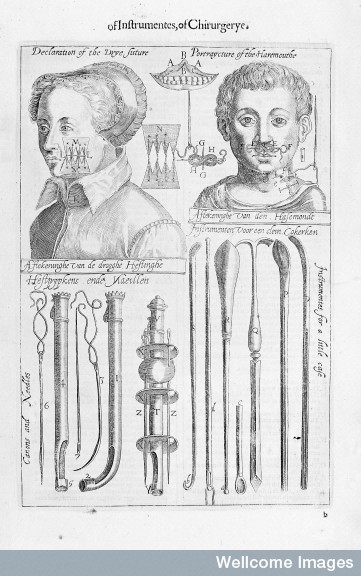
J. Guillemeau, operations on the cheek, for harelip. Wellcome Library, London

J. Guillemeau, operations on the cheek, for harelip. From “The Frenche chirurgerye,” 1597. Wellcome Library, London

However, pre-anaesthetic, this was a rather cruel and potentially traumatizing procedure. The patient was held tight by an assistant, while the surgeon cut open and subsequently stitched together the two halves of the lip with thin needles. The needles then remained in the lip and were taken out one by one over the course of days or even weeks.[1]

Even if the operation was successful, a child with a corrected cleft lip faced a lifelong stigma. Now known to be caused genetic or environmental factors, or a by a combination of both, in the eighteenth century cleft palate was still commonly explained by the theory of maternal imagination.[2] This meant that people believed that birth defects were impressed on the foetus during pregnancy because the mother had seen, imagined, or done something. In the case of cleft palate, explanation varied from the mother having unchaste thoughts to her having had intercourse with the devil. After all, in classic iconography as well as popular believe, the hare represents lust, probably because of its speed of reproduction, and sometimes the devil itself. No wonder many sufferers of cleft palate find the term ‘harelip’ offensive!

Many eighteenth-century anatomists and physicians already realized that it was unlikely that the maternal imagination, or morals for that matter, could influence the foetus. After all, deformations like cleft palate also occurred in animals, which have neither imagination nor reason. To make their point, these men started to collect animals with birth defects that were also found in humans, and they recorded case histories to prove the maternal imagination was a fantasy. For example, Dutch anatomists Eduard Sandifort wrote of a new born girl with a severe cleft palate that she was her parents’ eleventh child, the first with such a defect, and that they were good Christians.[3] However, the idea of the maternal imagination influencing the foetus was hard to eradicate: even in 1889, the authors of an encyclopaedia of children’s diseases still felt it was necessary to note that

“Pre-natal maternal impressions are often claimed as the cause of these marks [birth marks], and many cases are cited which lend a considerable degree of plausibility to the claim. It is more rational, however, to explain these cases by the principle of coincidence.”[4]


[1] A. Nuck, Operationes Et Experimenta Chirurgica (Leiden: Samuel Luchtmans, 1733), p. 73-77.

[2] M. Hagner, ‘Enlightened Monsters’, in William Clark, Jan Golinski and Simon Schaffer (eds.) The Sciences in Enlightened Europe (Chicago & London: The University of Chicago Press, 1999), pp. 175-217.

[3] E. Sandifort, Observationes Anatomico-Pathologicae 2 vols. (Leiden: P. v.d. Eyk et D. Vygh, 1777-1781), vol. II, liber IV, caput III, 29- 38.

[4] Cyclopaedia of the diseases of children, medical and surgical. The articles written especially for the work by American, British, and Canadian authors. John M. Keating (ed.), (Philadelphia: J. B. Lippincott company, 1889), p.104.

Medicine with a silver lining

In my research of early modern chemistry and medicine, I am currently focussing on the use of metals, particularly quicksilver. But other metals were also used widely, and the use of gold and silver is quite fascinating, in particular because it never disappeared entirely. In the late seventeenth century, silver was used to create aqua fortis or strong water, a kind of nitric acid.[1] This was used to treat skin conditions, and to dissolve gold and make dyes.  Silver was also used in medication that was supposed to strengthen the heart, but in 1747, Wouter van Lis refuted this: in his pharmaceutical handbook, he wrote that it is useless to add silver or gold to these drugs, as our body heat is incapable of solving them.

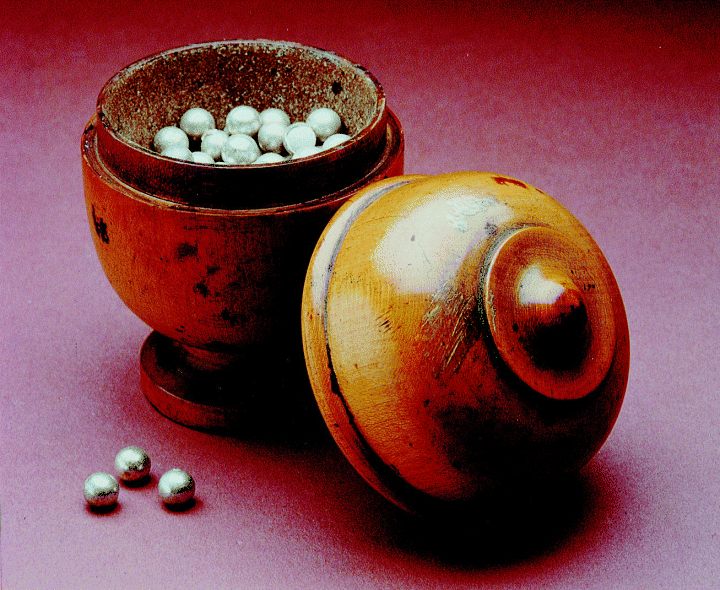
Van Lis had a point indeed: pure metallic silver and gold are not really toxic for the human body, as they are relatively resistant to corrosion by bodily processes. That is why eating small amounts of gold and silver leaf is harmless: European food additives E174 and E175 are simply silver and gold. This decorative use of precious metals was also familiar to Van Lis and his contemporaries: he noted that ‘…sometimes medication, like pills, is covered in silver or gold leave, to make it more pleasant to the eye.’[2] This covering was done in so-called pill silverers: spherical wooden containers on a small foot, into which silver or gold leave was put, moistened pills were added, and gentle swirling produced nicely silver or gold plated pills.

Pill silverer, probably nineteenth century.

Pill silverer, probably nineteenth century.

However, this innocuousness only goes for pure metallic precious metals, and not for compounds containing them, such as silver salts and colloidal silver. In the twentieth and twenty-first century, these have been advertised as a cure for a variety of ailments. They are sold as food supplements, thus avoiding the strict regulations that apply to medication. A sustained intake of these silver compounds can lead to argyria or silver poisoning.[3] Although very rare and unlikely to interfere with vital functions, it gives the sufferer an irreversible bluish-silver hue. The most famous recent case is probably Paul Karason, an American man who turned permanently blue after taking large amounts of a home made silver compound to cure his arthritis. Probably not exactly the kind of silver lining you’re looking for in a cure…


[1] Bisschop, Jan. Pharmacia Galenica & chymica, dat is Apotheker ende alchymiste ofte distilleer-konste : begrijpende de beginselen ende fondamenten der selver. Verdeylt in acht boecken, tot onderwijsinge der apothekers / Door een liefhebber derselver konste Nieu licht der apotekers en distilleerkonst. Antwerpen: Reynier Sleghers, 1667. p.361-2 http://books.google.nl/books?id=MFRAAAAAcAAJ&printsec=frontcover&hl=nl&source=gbs_atb#v=onepage&q&f=false.

[2] Van Lis, Wouter. Gualtheri van Lis Pharmacopoea galeno-chemico-medica… = Meng- schei- … / Wouter van Lis Meng- schei- en geneeskonstige artseny-winkel. Amsterdam: Jan Morterre, 1747. p.103: “Het is vergeefs, dat Silver en Gout by Hartsterkende Geneesmiddelen gemengt worden, alzoze door onze warmte niet kunnen ontbonden worden, nochtans bekleet men zomtyts Geneesmiddelen, om ze voor het oog aangenamer te maken, By voorbeelt Pillen, met Silver of Blatgout.”

[3] White, J. M. L., Powell, A. M., Brady, K. and Russell-Jones, R. (2003), Severe generalized argyria secondary to ingestion of colloidal silver protein. Clinical and Experimental Dermatology, 28: 254–256. doi: 10.1046/j.1365-2230.2003.01214.x

Dog balm

Recently, I wrote a blog about the use of human remains in early modern medicine. Humans were indeed not the only living beings that medical men thought to be useful in remedies. When I tried to gain a better understanding of a preparation of a dog with a cleft palate in the eighteenth-century Leiden University anatomical collections, I found an elaborate contemporary piece on the use of dogs in medicine. It had been written by Martinus Houttuyn (1720-1798), a Dutch natural philosopher who used Linneaus’ categorization of plants and animals to write a natural history in Dutch.[1] His work appeared in multiple volumes in the second half of the eighteenth century.

Houttuyn tried to list all the uses of dogs, from hunting, guarding and pulling carts to dinner and medicine. Although he dismissed the eating of dogs as only customary in other parts of the world, dogs could were very useful in medicine. ‘Young Dog Balm’, made out of young dogs boiled in olive oil with herbs and purified dog fat were used as chest relief balms. Small living dogs could be used as a kind of hot-water bag to treat colic pains, and having a dog lick a wound was thought to speed the healing process. The licking of a dog was also a tried cure for gout: having a dog lick the legs of a gout sufferer was likely to kill the dog, but it cured the patient. Similarly (and probably less messy for the client), socks of dog leather could be used to relieve bouts of gout, and gloves of dog skin were beneficial for rheumatic hands. Human skin was would have been even better than dog skin, but as this was scarce and expensive, dog skin was a good alternative.[2]

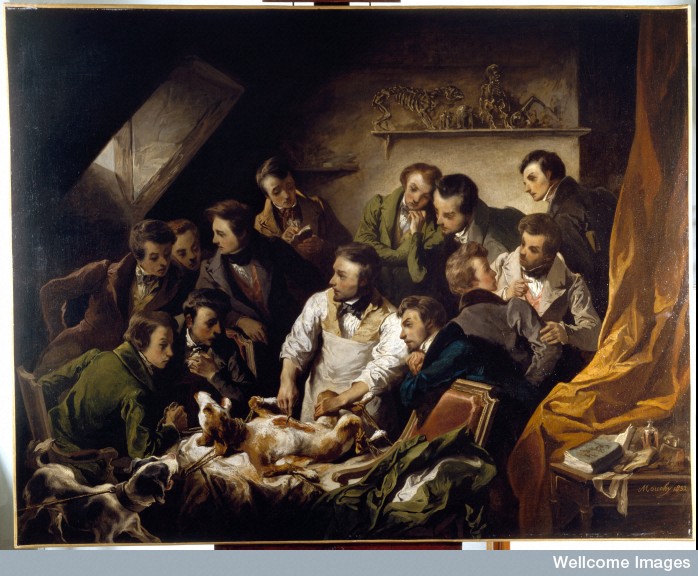
Dogs were also regularly used as stand-ins for humans in anatomy research, and were used frequently in vivisection experiments, leading Houttuyn to nickname the dog ‘Martyr of the Physicians.’

Wellcome Library, London. A physiological demonstration with vivisection of a dog. Oil painting by Emile-Edouard Mouchy, 1832.

Wellcome Library, London. A physiological demonstration with vivisection of a dog. Oil painting by Emile-Edouard Mouchy, 1832.

These examples of how dogs were used in medicine and medical research only two centuries ago demonstrate how culturally defined our relationship with certain kinds of animals is, and that it can change relatively quickly: with the rise of the popularity of the lap dog and the development of bacteriology and a chemical pharmaceutical industry in the nineteenth century, an anti-vivisectionist movement arose, and remedy contents like boiled dogs were not as generally accepted anymore.[3] However, we should not forget that dogs are still important in medical research aimed at developing cures for humans.[4]


[1] Houttuyn, M. (1761). Natuurlyke historie of uitvoerige beschryving der dieren, planten en mineraalen, volgens het samenstel van den heer Linnæus. Met naauwkeurige afbeeldingen / Martinus Houttuyn , Eerste deels, tweede stuk. Vervolg der zoogende dieren. Amsterdam, F. Houttuyn: 65-69.

[2] Jütte, R. (2003). Die Haut als Heilmittel. Verborgen im Buch – Verborgen im Körper: Haut zwischen 1500 und 1800. U. Zeuch, Wolfenbüttel: 161-166.

[3] On the rise of anti-vivisectionism in the late nineteenth-century Netherlands, see Kluveld, A. (2000). Reis door de hel der onschuldigen: de expressieve politiek van de Nederlandse anti-vivisectionisten, 1890-1940. Amsterdam, Amsterdam University Press., chapter 2.

[4] Medical Research Using Dogs as Models, http://www.sciencedaily.com/releases/2012/05/120509123657.htm (9 May 2012),

Scientific and Humane Issues in the Use of Random Source Dogs and Cats in Research. National Research Council (US) Committee on Scientific and Humane Issues in the Use of Random Source Dogs and Cats in Research. Washington (DC): National Academies Press (US); 2009. (http://www.ncbi.nlm.nih.gov/books/NBK32668/)

Hands-on history

For four years, I worked on my PhD dissertation about eighteenth-century anatomical preparations. Those preparations look pretty, many quite fragile, dangling in preservations fluid from a single horsehair in a glass phial. I was particularly interested in why these preparations were made, and how. The ‘why’ question can be answered fairly well by studying the preparations and related sources, such as contemporary letters, books, catalogues and lecture notes. The ‘how’ question though, is a completely different matter. Techniques to create lasting wet anatomical preparations were first developed from the late seventeenth century, and the first anatomists doing so were not too keen on everyone knowing their secret. That way, a good lasting preparation remained a sought after commodity.

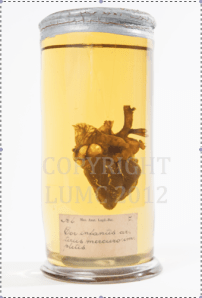
Heart injected with mercury and red wax, Eduard Sandifort, eighteenth century. Copyright LUMC 2012.

Heart injected with mercury and red wax, Eduard Sandifort, eighteenth century. Copyright LUMC 2012.

Yet this secrecy eventually disappeared as more and more preparations were required for research and teaching, and by the end of the eighteenth century, quite detailed handbooks on making anatomical preparations were available, such as Pole’s 1790 Anatomical Instructor. But does that mean it is easy to understand how an anatomical preparation was made in the eighteenth century? Not at all. Because these handbooks do describe materials and processes, but they also stress that the main things required are practice and patience. They are like cookbooks with very complicated recipes: you can have the book, all the ingredients and equipment described, follow the instructions minutely, and you can still mess up dinner massively because you are an inexperienced cook.

Like any art, any practical skill, creating an anatomical preparation is something you can only do successfully if you practice patiently. To gain a better understanding of this practice, at some point my colleagues and I decided that we had to try to create a preparation ourselves, using the eighteenth-century handbooks and materials that resembled those listed as close as possible. That is how we ended up trying to inject sheep hearts with warm blue and red wax on two February afternoons in early 2012. It turned out to be even harder then we anticipated. The wax had to be very hot in order not to harden straight away, so we kept the hearts in an au-bain-marie, but the water had to be so warm we almost burned our hands. According to the instructions, injecting the wax through particular veins, it should eventually also be pushed into the smallest blood vessels, but whatever we tried, it didn’t happen.

Sheep heart injected with red and blue wax, February 2012.

Sheep heart injected with red and blue wax, February 2012.

And then I did not even mention the difficulties we had obtaining the right ingredients for the wax masses and mixing them according to the recipes, the stink of the hearts and the hot turpentine, the difficulty we had discerning the right veins for injection and tying of the others to prevent the wax from leaking out again. If we were already having so much trouble doing this in an age of electric lighting, refrigeration, and the internet, how difficult must it have been for an eighteenth-century anatomist? I already admired the old preparations for their refined details, and that admiration only increased because of our own experiment. What this shows is that trying to reproduce historical experiments and production techniques enhances our understanding of historical practices and objects enormously, in a way that is impossible if you only study written and visual sources. Sometimes, history research has to be very hands-on.

Mercury or mercury?

In previous posts, I have written about the historical omnipresence of mercury in medicine. For my new research project, I am trying to figure out how the first academic chemists looked at mercury, and whether the experiments they did with it changed the way mercury was used in drugs. In the early eighteenth century, the chemical laboratory was slowly but steadily integrated in university research and teaching. Taking its materials and procedures mostly from traditional alchemy, the early academic chemists tried to distance themselves and their new practice from the negative associations alchemy also included, like quackery and gold making.

Image

Herman Boerhaave

The academic chemists wanted to combine laboratory practice and philosophy to gain an better understanding of the composition and characteristics of all kinds of materials, and hoped this would also enable them to improve the effectiveness of medical remedies. For example, the famous Leiden professor of botany, medicine and chemistry Herman Boerhaave (1668-1738) spend a substantial part of the last decade of his live experimenting with mercury. He wondered whether purified mercury was the primal matter that could serve as a universal remedy.

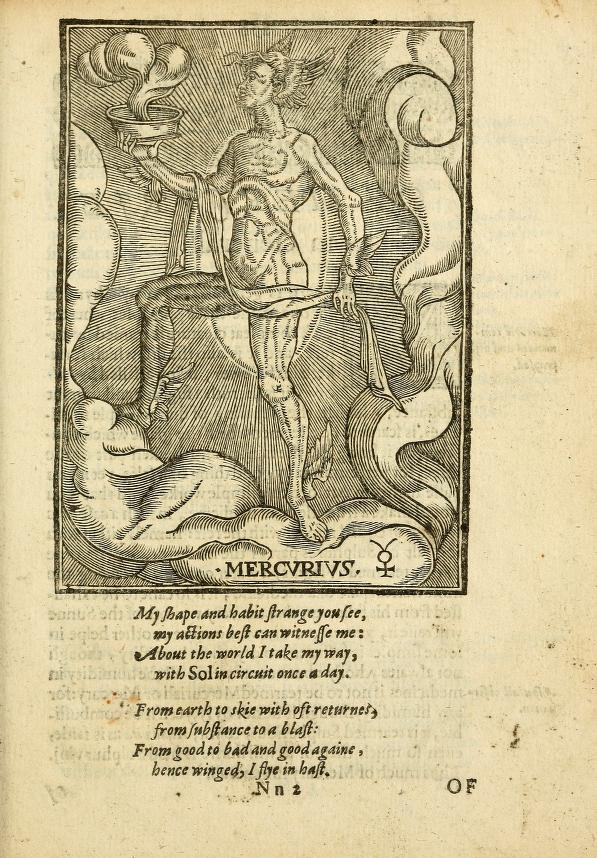
Not very surprising, because the actual substance of mercury was thought to have the same qualities as the god Mercury and philosophical mercury, an alchemical concept which was not necessarily the same as the actual material. I know, this sounds vague, and it is – part of my research project is trying to find out whether the early academic chemists actually distinguished between philosophical and material mercury, or that they saw them as interchangeable entities with the same qualities. This multiplicity of mercury is nicely demonstrated in John Woodall’s 1617 The Ships’ Surgeons’ Mate, a handbook for young ships’ surgeons’ with little training on how to dress wounds, use chirurgical instruments and prepare medication.

Image

‘Mercury,’ from John Woodall, The Ships’ Surgeons’ Mate, 1617.

Apart from these practical instructions, the book also contains two six-page poems, one on the virtues of mercury, and one on those of sulfur – traditionally thought to be the hot, red, dry natural opposite of cool, silvery white, wet mercury. The image of the god mercury shown here precedes the poem on the virtues of mercury, and bears a short caption on the character of Mercury, or mercury:

My shape and habit strange you see,

my actions best can witnesse me;

About the world I take my way,

 with Sol in circuit once a day.


From earth to skie with oft returnes,

from substance to a blast;

From good to bad and good againe,

hence winged, I fly in haste.


In this text, we see that a number of characteristics of the substance / planet / god are effortlessly combined: the strange shape and habits of the metal that can change from a substance to a vapour, a ‘blast;’ the planet that orbits the sun and is thus circled by earth once a day, and the winged, hastily flying messenger god. Also, it mentions that mercury has a good and a bad side, something that is also stressed in the last verse of the poem on sulfur: “Though Sulphur, Sal and Mercurie, have healing medicines store, yet know the’ have poison and can kill, prepare them well therefore.” To be continued!

The practical uses of a mummie

In our culture, we have a deeply ingrained aversion against ingesting other people’s bodies and bodily substances. Or don’t we? It seems a bit random, as exchanges of certain bodily fluids between partners are generally accepted as long as it happens in private, as are blood and organ donations. Yet the idea of ingesting (preparations of) human flesh, bones, blood, hair, nails, urine, and other excrements evokes associations with cannibalism, which is a big taboo. However, historically speaking, this aversion is fairly recent and the practical uses of death human bodies were quite varied.

For example, as my colleague Lindsey Fitzharris pointed out on her brilliant blog The Chirurgeon’s Apprentice earlier this year, anthropodermic bibliopegy, or book covers made of human skin were quite mainstream items once, particularly around the French revolution. And it didn’t stop at book covers: up until the eighteenth century, human remains were regularly used in drugs. Richard Sugg wrote a fascinating book about this, Mummies, Cannibals and Vampires. The History of Corpse Medicine from the Renaissance to the Victorians (Routledge, London 2011). Sugg’s work is based mainly on English-language sources, but ‘corpse medicine’ was a phenomenon through all of Europe, and the Low Countries were no exception.

Tim Huisman in his 2009 book on the Leiden anatomical theatre, The Finger of God (Primavera Press, p.50), mentioned that Otto Heurnius (1577-1652), the keeper of the anatomical theatre, was particularly pleased when he obtained an Egyptian mummie in 1620. Not just because it was such a great showpiece, but also because the mummified

Otto Heurnius

human flesh was thought to have great healing qualities – even better than human flesh from Tenerife, Napels or the African desert. According to Heurnius, this was due to the specific mix of spices used in the embalming process.

So I was not entirely surprised this week when I found various recipes listing human bodily tissue in the Collectanea chymica Leidensia (1684, various reprints), a book consisting of drug recipes by Leiden University chemistry professors compiled by an English student. Cadavers, mummie, embryos and human blood are all listed as simplica (base ingredients), apparently without causing any controversy.

The recipe for preparing ‘mummie’ on page 317 in the 1693 edition calls for the flesh of a human who died a violent death (“Carnis hominis, violenta morte perempti”) and the resulting preparation was apparently very helpful in internal lesions, hemorrhaged lungs and ‘marasmo’ or loss of strength, to name a few ailments. Strange as it may sound to us now, the idea was probably that a person who died a violent dead was most likely not very calm at the time of his death, and that this excitement could be preserved in his flesh and subsequently transferred successfully to the body of the patient, where it would have a healing and invigorating effect.

A morbidly fascinating topic, yet the pressing question that is raised by the ubiquitous seventeenth-century drug recipes involving human bodily material is of course: where did it all come from? Obviously there weren’t enough Egyptian mummies around, as the recipe quoted above describes making ‘mummie’ out of the flesh of any person who died a violent death. Sugg suggests convicted criminals, which is a realistic possibility, because they were also used for anatomical demonstrations. However, those were scarce too, and although it is not clear how often human-based drugs were prescribed, it is possible that material was sometimes delivered on demand…