Dog balm

Recently, I wrote a blog about the use of human remains in early modern medicine. Humans were indeed not the only living beings that medical men thought to be useful in remedies. When I tried to gain a better understanding of a preparation of a dog with a cleft palate in the eighteenth-century Leiden University anatomical collections, I found an elaborate contemporary piece on the use of dogs in medicine. It had been written by Martinus Houttuyn (1720-1798), a Dutch natural philosopher who used Linneaus’ categorization of plants and animals to write a natural history in Dutch.[1] His work appeared in multiple volumes in the second half of the eighteenth century.

Houttuyn tried to list all the uses of dogs, from hunting, guarding and pulling carts to dinner and medicine. Although he dismissed the eating of dogs as only customary in other parts of the world, dogs could were very useful in medicine. ‘Young Dog Balm’, made out of young dogs boiled in olive oil with herbs and purified dog fat were used as chest relief balms. Small living dogs could be used as a kind of hot-water bag to treat colic pains, and having a dog lick a wound was thought to speed the healing process. The licking of a dog was also a tried cure for gout: having a dog lick the legs of a gout sufferer was likely to kill the dog, but it cured the patient. Similarly (and probably less messy for the client), socks of dog leather could be used to relieve bouts of gout, and gloves of dog skin were beneficial for rheumatic hands. Human skin was would have been even better than dog skin, but as this was scarce and expensive, dog skin was a good alternative.[2]

Dogs were also regularly used as stand-ins for humans in anatomy research, and were used frequently in vivisection experiments, leading Houttuyn to nickname the dog ‘Martyr of the Physicians.’
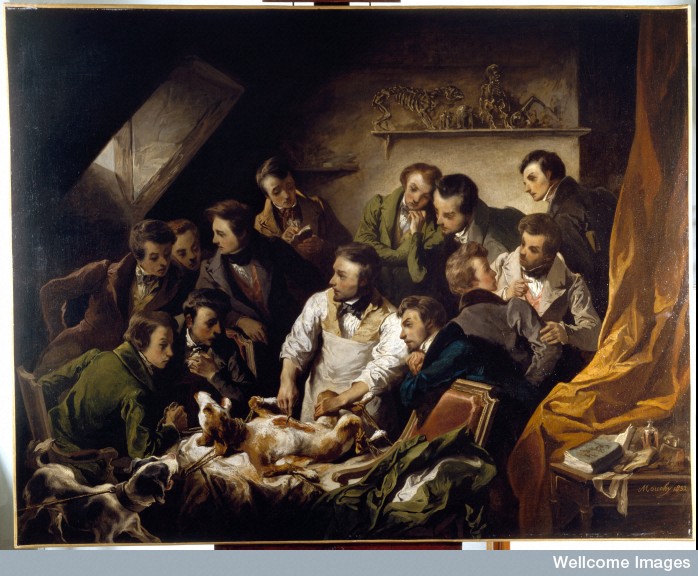
Wellcome Library, London. A physiological demonstration with vivisection of a dog. Oil painting by Emile-Edouard Mouchy, 1832.

Wellcome Library, London. A physiological demonstration with vivisection of a dog. Oil painting by Emile-Edouard Mouchy, 1832.

These examples of how dogs were used in medicine and medical research only two centuries ago demonstrate how culturally defined our relationship with certain kinds of animals is, and that it can change relatively quickly: with the rise of the popularity of the lap dog and the development of bacteriology and a chemical pharmaceutical industry in the nineteenth century, an anti-vivisectionist movement arose, and remedy contents like boiled dogs were not as generally accepted anymore.[3] However, we should not forget that dogs are still important in medical research aimed at developing cures for humans.[4]


[1] Houttuyn, M. (1761). Natuurlyke historie of uitvoerige beschryving der dieren, planten en mineraalen, volgens het samenstel van den heer Linnæus. Met naauwkeurige afbeeldingen / Martinus Houttuyn , Eerste deels, tweede stuk. Vervolg der zoogende dieren. Amsterdam, F. Houttuyn: 65-69.

[2] Jütte, R. (2003). Die Haut als Heilmittel. Verborgen im Buch – Verborgen im Körper: Haut zwischen 1500 und 1800. U. Zeuch, Wolfenbüttel: 161-166.

[3] On the rise of anti-vivisectionism in the late nineteenth-century Netherlands, see Kluveld, A. (2000). Reis door de hel der onschuldigen: de expressieve politiek van de Nederlandse anti-vivisectionisten, 1890-1940. Amsterdam, Amsterdam University Press., chapter 2.

[4] Medical Research Using Dogs as Models, http://www.sciencedaily.com/releases/2012/05/120509123657.htm (9 May 2012),

Scientific and Humane Issues in the Use of Random Source Dogs and Cats in Research. National Research Council (US) Committee on Scientific and Humane Issues in the Use of Random Source Dogs and Cats in Research. Washington (DC): National Academies Press (US); 2009. (http://www.ncbi.nlm.nih.gov/books/NBK32668/)
Hands-on history

For four years, I worked on my PhD dissertation about eighteenth-century anatomical preparations. Those preparations look pretty, many quite fragile, dangling in preservations fluid from a single horsehair in a glass phial. I was particularly interested in why these preparations were made, and how. The ‘why’ question can be answered fairly well by studying the preparations and related sources, such as contemporary letters, books, catalogues and lecture notes. The ‘how’ question though, is a completely different matter. Techniques to create lasting wet anatomical preparations were first developed from the late seventeenth century, and the first anatomists doing so were not too keen on everyone knowing their secret. That way, a good lasting preparation remained a sought after commodity.

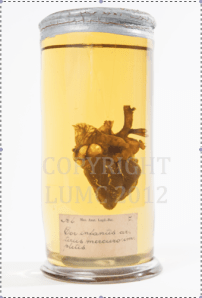
Heart injected with mercury and red wax, Eduard Sandifort, eighteenth century. Copyright LUMC 2012.

Heart injected with mercury and red wax, Eduard Sandifort, eighteenth century. Copyright LUMC 2012.

Yet this secrecy eventually disappeared as more and more preparations were required for research and teaching, and by the end of the eighteenth century, quite detailed handbooks on making anatomical preparations were available, such as Pole’s 1790 Anatomical Instructor. But does that mean it is easy to understand how an anatomical preparation was made in the eighteenth century? Not at all. Because these handbooks do describe materials and processes, but they also stress that the main things required are practice and patience. They are like cookbooks with very complicated recipes: you can have the book, all the ingredients and equipment described, follow the instructions minutely, and you can still mess up dinner massively because you are an inexperienced cook.

Like any art, any practical skill, creating an anatomical preparation is something you can only do successfully if you practice patiently. To gain a better understanding of this practice, at some point my colleagues and I decided that we had to try to create a preparation ourselves, using the eighteenth-century handbooks and materials that resembled those listed as close as possible. That is how we ended up trying to inject sheep hearts with warm blue and red wax on two February afternoons in early 2012. It turned out to be even harder then we anticipated. The wax had to be very hot in order not to harden straight away, so we kept the hearts in an au-bain-marie, but the water had to be so warm we almost burned our hands. According to the instructions, injecting the wax through particular veins, it should eventually also be pushed into the smallest blood vessels, but whatever we tried, it didn’t happen.

Sheep heart injected with red and blue wax, February 2012.

Sheep heart injected with red and blue wax, February 2012.

And then I did not even mention the difficulties we had obtaining the right ingredients for the wax masses and mixing them according to the recipes, the stink of the hearts and the hot turpentine, the difficulty we had discerning the right veins for injection and tying of the others to prevent the wax from leaking out again. If we were already having so much trouble doing this in an age of electric lighting, refrigeration, and the internet, how difficult must it have been for an eighteenth-century anatomist? I already admired the old preparations for their refined details, and that admiration only increased because of our own experiment. What this shows is that trying to reproduce historical experiments and production techniques enhances our understanding of historical practices and objects enormously, in a way that is impossible if you only study written and visual sources. Sometimes, history research has to be very hands-on.

Mercury or mercury?

In previous posts, I have written about the historical omnipresence of mercury in medicine. For my new research project, I am trying to figure out how the first academic chemists looked at mercury, and whether the experiments they did with it changed the way mercury was used in drugs. In the early eighteenth century, the chemical laboratory was slowly but steadily integrated in university research and teaching. Taking its materials and procedures mostly from traditional alchemy, the early academic chemists tried to distance themselves and their new practice from the negative associations alchemy also included, like quackery and gold making.

Image

Herman Boerhaave

The academic chemists wanted to combine laboratory practice and philosophy to gain an better understanding of the composition and characteristics of all kinds of materials, and hoped this would also enable them to improve the effectiveness of medical remedies. For example, the famous Leiden professor of botany, medicine and chemistry Herman Boerhaave (1668-1738) spend a substantial part of the last decade of his live experimenting with mercury. He wondered whether purified mercury was the primal matter that could serve as a universal remedy.

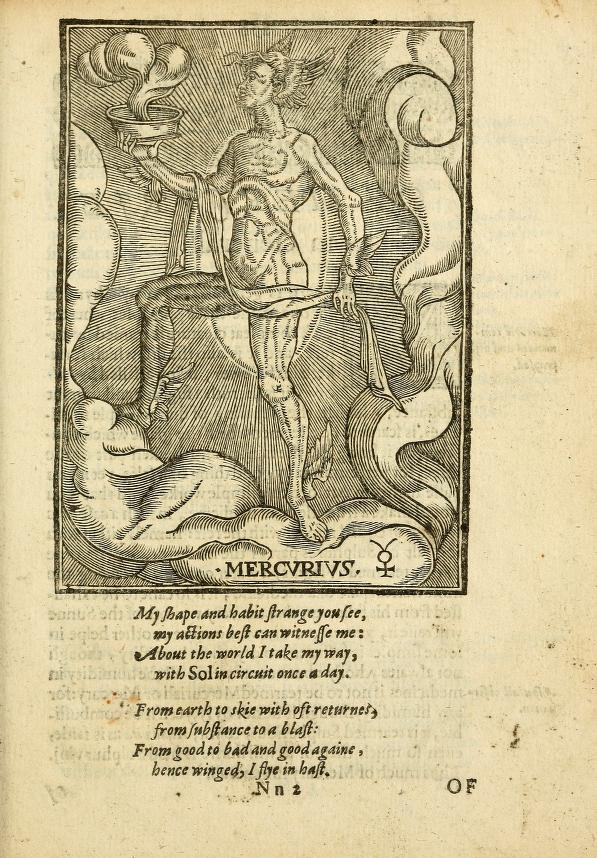
Not very surprising, because the actual substance of mercury was thought to have the same qualities as the god Mercury and philosophical mercury, an alchemical concept which was not necessarily the same as the actual material. I know, this sounds vague, and it is – part of my research project is trying to find out whether the early academic chemists actually distinguished between philosophical and material mercury, or that they saw them as interchangeable entities with the same qualities. This multiplicity of mercury is nicely demonstrated in John Woodall’s 1617 The Ships’ Surgeons’ Mate, a handbook for young ships’ surgeons’ with little training on how to dress wounds, use chirurgical instruments and prepare medication.

Image

‘Mercury,’ from John Woodall, The Ships’ Surgeons’ Mate, 1617.

Apart from these practical instructions, the book also contains two six-page poems, one on the virtues of mercury, and one on those of sulfur – traditionally thought to be the hot, red, dry natural opposite of cool, silvery white, wet mercury. The image of the god mercury shown here precedes the poem on the virtues of mercury, and bears a short caption on the character of Mercury, or mercury:

My shape and habit strange you see,

my actions best can witnesse me;

About the world I take my way,

 with Sol in circuit once a day.


From earth to skie with oft returnes,

from substance to a blast;

From good to bad and good againe,

hence winged, I fly in haste.


In this text, we see that a number of characteristics of the substance / planet / god are effortlessly combined: the strange shape and habits of the metal that can change from a substance to a vapour, a ‘blast;’ the planet that orbits the sun and is thus circled by earth once a day, and the winged, hastily flying messenger god. Also, it mentions that mercury has a good and a bad side, something that is also stressed in the last verse of the poem on sulfur: “Though Sulphur, Sal and Mercurie, have healing medicines store, yet know the’ have poison and can kill, prepare them well therefore.” To be continued!

The practical uses of a mummie

In our culture, we have a deeply ingrained aversion against ingesting other people’s bodies and bodily substances. Or don’t we? It seems a bit random, as exchanges of certain bodily fluids between partners are generally accepted as long as it happens in private, as are blood and organ donations. Yet the idea of ingesting (preparations of) human flesh, bones, blood, hair, nails, urine, and other excrements evokes associations with cannibalism, which is a big taboo. However, historically speaking, this aversion is fairly recent and the practical uses of death human bodies were quite varied.

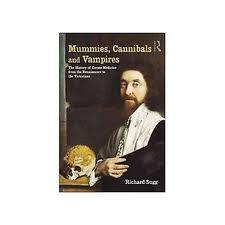
For example, as my colleague Lindsey Fitzharris pointed out on her brilliant blog The Chirurgeon’s Apprentice earlier this year, anthropodermic bibliopegy, or book covers made of human skin were quite mainstream items once, particularly around the French revolution. And it didn’t stop at book covers: up until the eighteenth century, human remains were regularly used in drugs. Richard Sugg wrote a fascinating book about this, Mummies, Cannibals and Vampires. The History of Corpse Medicine from the Renaissance to the Victorians (Routledge, London 2011). Sugg’s work is based mainly on English-language sources, but ‘corpse medicine’ was a phenomenon through all of Europe, and the Low Countries were no exception.

Tim Huisman in his 2009 book on the Leiden anatomical theatre, The Finger of God (Primavera Press, p.50), mentioned that Otto Heurnius (1577-1652), the keeper of the anatomical theatre, was particularly pleased when he obtained an Egyptian mummie in 1620. Not just because it was such a great showpiece, but also because the mummified

Otto Heurnius

human flesh was thought to have great healing qualities – even better than human flesh from Tenerife, Napels or the African desert. According to Heurnius, this was due to the specific mix of spices used in the embalming process.

So I was not entirely surprised this week when I found various recipes listing human bodily tissue in the Collectanea chymica Leidensia (1684, various reprints), a book consisting of drug recipes by Leiden University chemistry professors compiled by an English student. Cadavers, mummie, embryos and human blood are all listed as simplica (base ingredients), apparently without causing any controversy.

The recipe for preparing ‘mummie’ on page 317 in the 1693 edition calls for the flesh of a human who died a violent death (“Carnis hominis, violenta morte perempti”) and the resulting preparation was apparently very helpful in internal lesions, hemorrhaged lungs and ‘marasmo’ or loss of strength, to name a few ailments. Strange as it may sound to us now, the idea was probably that a person who died a violent dead was most likely not very calm at the time of his death, and that this excitement could be preserved in his flesh and subsequently transferred successfully to the body of the patient, where it would have a healing and invigorating effect.

A morbidly fascinating topic, yet the pressing question that is raised by the ubiquitous seventeenth-century drug recipes involving human bodily material is of course: where did it all come from? Obviously there weren’t enough Egyptian mummies around, as the recipe quoted above describes making ‘mummie’ out of the flesh of any person who died a violent death. Sugg suggests convicted criminals, which is a realistic possibility, because they were also used for anatomical demonstrations. However, those were scarce too, and although it is not clear how often human-based drugs were prescribed, it is possible that material was sometimes delivered on demand…

The seventeenth-century pharmacy: learning by doing

After focusing on objects and materiality for a bit, this week I returned to the library to read texts. It struck me once again how dense very small pieces of text can be. Part of my new project on metals in Boerhaavian chemistry is getting an idea of how popular and academic medicine worked in practice before Boerhaave. To this end, I am reading late seventeenth-century chemical and pharmaceutical handbooks. From just the two-page foreword of a Dutch 1667 ‘Galenic and Chymical’ pharmaceutical handbook, I could derive the so much about how a seventeenth-century pharmacy functioned, that I want to share it with you.

This handbook is a bit of an exception as it is Dutch, while most chemical and pharmaceutical handbooks of the time were in Latin. But although apothecaries were generally expected to understand Latin, in practice this was not always the case. Unlike today, an apothecary did not need a university degree to practice, and most learned their trade as an apprentice after a couple of years at school. This education system made perfect sense to the author of the handbook, as many of the common ‘compositions’ made by the apothecary were not described in any book: making them was tacit knowledge, not even transferred from master to apprentice orally, but through demonstration and doing.

Title page of the 1657 first edition of the ‘Pharmacia Galenica & Chymica.’

As a sort of supplement to this very practical training, this particular handbook was aimed at young student-apothecaries, and advised them to make sure they learned the Latin names of all the Simplica and herbs (base ingredients) by heart. The author – a Jesuit apothecary – suggests several ways in which this could be achieved: by keeping a list of all the simplica supplied by the druggist and frequently pouring over this, by studying herbaria and other books, by regularly checking the written signs in the apothecary garden, and by looking up the herbs brought in by the ‘herb-fetchers’ (Kruydt-haelders) in books and marking them appropriately after drying.

From this advice, we can deduct a number of other things, like that the apothecary and his apprentice were part of a professional network consisting of at least a druggist and a herb-fetcher. The herb-fetcher is described as getting all the herbs growing in the wild for the apothecary in the cities, and the druggist functioned as a sort of whole-seller of base ingredients for the apothecary. The text also indicates that an apothecary generally had his own herb garden and books, and combined with the fact that he needed to understand at least some Latin, this made the profession a quite respectable one.

We still tend to think of apothecary as a quite respectable profession, but by no means do we think of the apothecary and the alchemist as closely related professions. Yet in the seventeenth century they were: the title page of this handbook reads ‘Galenic & Chymical Pharmacy, That is: Apothecary and Alchymist’ (Pharmacia Galenica & Chymica, Dat is: Apotheker en Alchymiste).


Source: Bisschop, Jan. Pharmacia Galenica & Chymica, Dat Is Apotheker Ende Alchymiste Ofte Distilleer-konste: Begrijpende De Beginselen Ende Fondamenten Der Selver. Verdeylt in Acht Boecken, Tot Onderwijsinge Der Apothekers / Door Een Liefhebber Derselver Konste Nieu Licht Der Apotekers En Distilleerkonst. Antwerpen: Reynier Sleghers, 1667.


The mysteries of mercury

The medicine chest was closed for a week as some moving countries and organising a PhD defence had to be done, but now a new project has been started and it offers endless opportunities for new, fascinating blogs!

As we have seen before, mercury was a hughely popular substance in nineteenth- century drugs, but that popularity already had a long history. In traditional alchemy, mercury was a very important element. Together with sulphur, it was thought to be the origin of all metals, and that through the right processes of distillation and purification of these two, the alchemist would eventually be able to create (philosophical) gold. In line with this, mercury was thought to be a live-giving substance with strong penetrating qualities and thus a useful medicine in ailments that required a thorough purge of the body.

A Chinese emperor even had his tomb filled with rivers of mercury als he thought they might help him find eternal life – ironically, he probably died from taking mercury pills. However, by the seventeenth century it was known that mercury had a dangerous side, and this dual character, together with mercury’s mysterious shimmer and its volatile nature, made it all the more fascinating. Mercury was everywhere until the twentieth century, both in popular and academic chemistry and medicine, as also shows from a late seventeenth-century Dutch book of plates on the crafts, Jan Luyken’s Het Menselijk Bedrijf (‘Man’s activities’) of 1694. In it, a plate is found of a ‘scheider,’ literally a seperator, an alchemist of chemist.

20121027-130736.jpg

With the plate comes a poem: “Ik schei de kwik in twee geslachten; in goede en een kwade, om zich te wachten. In zoet, en in verterend vuur, en dwing haar vluchtige natuur.” This translates as “I seperate mercury in two genders; in good and bad, to make it wait. In sweet, and in digesting fire, and force her volatile nature.” This suggests that it was popular believe that the two characteristics of mercury, the good and the bad, the live-giving and the killing, could be seperated through destillation – and that the remaining residue, that was forced to ‘wait’ was the good part that could be used in medicine.

That mercury was used as a cure-all by virtually anyone who could afford it, is also nicely illustrated by the mummie of Ferdinand II (1467-1496), king of Napels, aka Little Ferdinand. His hair contained the remains of head lice, as well as high concentration of mercury – Ferdinand used it as lice shampoo. In my new research project, I will try to find out exactly how mercury was thought to influence the human body in early eighteenth-century Dutch popular alchemy and academic chemistry, and in these two fields really differed in their ideas.

Medicine chest or kitchen cabinet?

Over the past weeks, some nasty and exotic substances from nineteenth-century medicine chests have been presented. Today however, I am going to focus on some substances that are commonly found in nineteenth-century medicine chests, but that are also still in most kitchens today.

“Spirit of Hartshorn” for example, sounds very mysterious, but is in fact nothing more than an ammonia solution. The Romans called the ammonium chloride deposits they collected in ancient Libya ‘sal ammoniacus’ (salt of Amun) because of proximity to the nearby temple of Amun or Ammon. Before the mid-nineteenth century, this compound of nitrogen and hydrogen (NH3) was usually made from horn shavings, hence the name ‘spirit of hartshorn.’ We now keep its chemically manufactured equivalent in our cleaning cupboards. In medicine chests the substance can be found under various names, such as Liq. Ammon Fort., and it was used to treat stings and insect bites, as it reduces pain an irritation of the skin.

You’d be surprised what you can do with spices…


Other substances that are very common in nineteenth-century medicine chests are all kinds of spices and plant extracts, such as ground ginger, rhubarb powder, and clove oil. Most of these were introduced in Europe in the sixteenth century, when explorers and traders brought them back from newly discovered regions. Rhubarb however was indigenous, although in the nineteenth century medical handbooks sometimes distinguished between various geographical origins, i.e. Turkish and European rhubarb. Savory, a chemist, stated that rhubarb was “…an excellent remedy in case of flatulent affection of the bowels attended with griping pains, and in diarrhoea free from inflammation; but it should not be indiscriminately administered in every case of pain in the bowels, on account of the stimulating nature of the spirit with which it is prepared.” [1]

Ginger, either dried and powdered or in the form of an essence, was advised in all kinds of ailments, but particularly in cholic and gout. It was thought to be warming, and with a more lasting effect than other spices.[2] Rhubarb and ginger were also often combined, most famously in Gregory’s Powder. This mixture of rhubarb, ginger and magnesium carbonate was one of the most common self-prescription medicines for over a hundred and fifty years after it had been developed by James Gregory (1752-1821), a professor of physic in Edinburgh.[3]

In the Dublin Literary Gazette in 1830, we find an advertisement for  “DR. GREGORY’S STOMACHIC POWDER of Rhubarb, Ginger, and Calcined Magnesia, for Indigestion, Flatulence, Acidity, &e.”

Clove oil may not be in your spice rack, but cloves, whole or powdered, probably are – and even today sucking on a clove may alleviate a toothache, albeit temporarily. Clove oil can also still be purchased in pharmacies without a prescription. This is because the active ingredient, eugenol, is a natural analgaesic and antiseptic. For that reason, clove oil is found in so many medicine chests from the nineteenth century, especially in chests that were assembled for travellers. They could easily find themselves many days away from a dentist, and then clove oil was their first resort. All this shows that while many nineteenth-century drugs were ineffective or even harmful, some were innocent and even quite useful.


[1] Savory, A companion to the medicine chest, 1836, p. 92

[2] Bond’s Companion to the Medicine Chest, ca. 1862 p. 25

Quinine in the Arctic

Quinine – most of us have heard of it and associate it with the treatment of malaria. Recently a certain manufacturer of soft drinks even mentioned it again in a sort of mock-colonial advert for tonic water. Although tonic water was indeed originally mixed as an anti-malaria treatment in tropical regions, what the ad does not mention is that our tonic water contains less than 20 milligrams of quinine per 1.5 decilitre, whereas the recommended quinine dosage for treatment of malaria is two or three 200-350 milligram tablets three times a day.[1]

In several of the medicine chests at the National Maritime Museum, preparations of quinine are also found, including quinine disulphate in a chest that was used by the ill-fated Franklin expedition to the Arctic (1845).[2] Searching for a North-western passage to Asia, all 128 men died after their boats got stuck in the ice in the Canadian Arctic.[3] Seen through twenty-first century eyes, it may seem very odd to take anti-malaria drugs on an Arctic expedition. Upon closer investigation, it is not as strange as it seems.

A nineteenth-century bottle of a quinine preparations, like the one in the chest of the Franklin expedition.

Quinine, an alkaloid made of the bitter red bark of the cinchona tree, was ‘discovered’ in Peru in 1631. It was no chance discovery – the Quechua already knew it, but malaria was not indigenous to the new world. In fact, the discovery of the usefulness of quinine in malaria by a Jesuit apothecary was the result of  a search commanded by Pope Urban VIII, after ten cardinals and hundreds of their attendants who came to Rome to elect a new pope died in the Roman marshes in 1623 from ‘bad air’ or, in Italian, mal’aria.[4]

Unlike what many people think nowadays, malaria is not unique to tropical regions. Until the early twentieth century, it was indigenous to much of Europe. Epidemics regularly occurred in regions as northern as Denmark and even Finland.[5] Moreover, the malaria parasite was not discovered until 1880 by the French army surgeon Charles Louis Alphonse Laveran (who received a Nobel prize for his discovery in 1907).[6] So until 1880, malaria was literally mal’aria: a disease characterized by intermittent fevers, thought to be caused by ‘bad air.’

Obviously, this ‘bad air’ could occur anywhere, so it made perfect sense to the men on Franklin’s expedition to take it with them on their Arctic explorations. There is a fair chance they too mixed it with other beverages though, as the quinine disulphate they brought with them tasted so bitter that it induced vomiting before it could have any therapeutic effect…

Image source: http://carmichael.lib.virginia.edu/story/pharmacy.html


[2] Catalogue numbers AAA2224.18, TOA0131.4

[3] John Geiger and Owen Beattie, Frozen in Time: The Fate of the Franklin Expedition. Bloomsbury Publishing PLC, 2004

[4] Fiammetta Rocco, The Miraculous Fever-Tree: Malaria, Medicine and the Cure that Changed the World. HarperCollins 2010

[5] Reiter, Paul. “Global warming and malaria: knowing the horse before hitching the cart”. Malaria Journal 7 (2008): suppl. 1.

Hidden opiates and mercury

About two weeks ago, I had coffee with the head of the conservation department of the National Maritime Museum. She asked me if I could mark the bottles and containers from the medicine chests in the database that had potentially hazardous substances in them. As I compiled a list of all the substances and their contemporary uses for my research project anyway, I promised her to do so.

Obviously, many of the substances in the chest can be hazardous if you would swallow an entire bottle at once, but the conservation department is particularly interested in substances that are either a health risk if not properly stored, such as mercury, and substances that are subject to legal regulations, such as opiates. Even if the opium is over a century old, you still need a license to keep it! And as a matter of fact, there are quite some hidden opiates and mercury in the medicine chests.

Some of them are quite easy to recognise, because their label reads something like ‘Hydr.’ (hydrargyrum; mercury), or ‘compound powder of chalk with opium’, and anyone who has ever read a Victorian novel will know laudanum should not be spoon-fed to infants – although one can imagine it would make them very calm. However, others are less straightforward. Grey powder, blue pills, Dover’s powder, paregoric elixir, and calomel or calamel all contain mercury or opium.

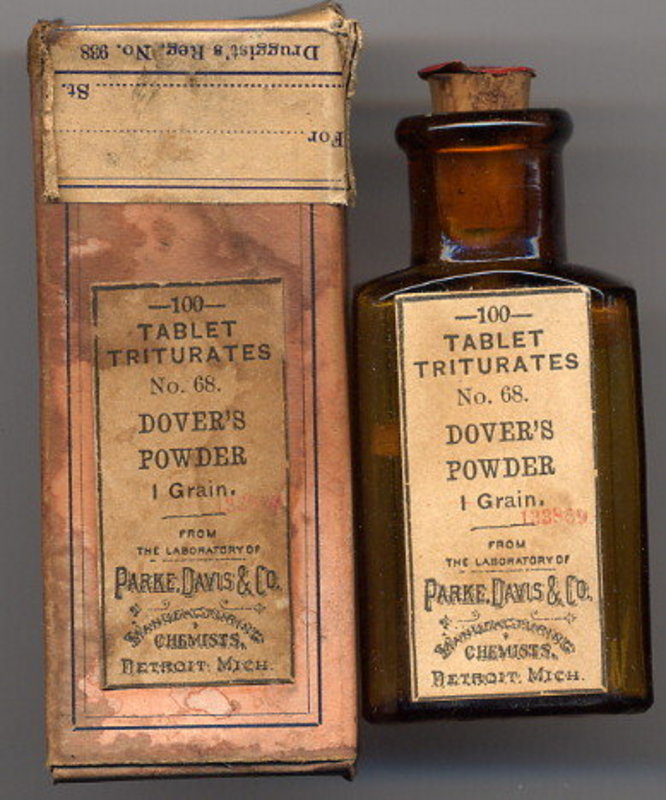
Dover’s powder for example, was a traditional medicine against cold and fever developed by Thomas Dover (1660–1742), aka Doctor Quicksilver. Its’ recipe i  Encyclopaedia Britannica: Or a Dictionary of Arts, Sciences and Miscellaneous Litterature of 1810 says:

“Sudorific, or Dover’s powder. E. Take of vitriolated tartar, three drams; opium, root of ipecacuanha powdered, of each one scruple. Mix, and grind them accurately together, so as to make an uniform powder.”

A late nineteenth century bottle of Dover’s Powder – advertised as fever medicine.

But Dover was certainly not the only or the last physician to subscribe mercury-based drugs to his patients. Medication with mercury as the active ingredient was used in the treatment of venereal and skin diseases up to the early twentieth century, and in the nineteenth century they could be found in both traveller’s and family medicine chests in abundance. Turnbull in his 1806 book The Naval Surgeon writes that John Clark  in 1773 was the first to use calomel (mercury chloride) in dysentery in ‘hot countries’.

John Savory, in his 1836 A Companion to the Medicine Chest wrote of calomel: “This mercurial preparation is more extensively and more usefully employed than almost any other article of the Materia Medica. But its principal use is as a purge, conjoined with other aperients; and for this purpose it is administered in doses of from three to six grains, combined with, or followed by, cathartic extract, rhubarb, senna, or other laxatives. (…) In affections of the liver, in various glandular diseases, and in some cutaneous eruptions, calomel is celebrated as an alternative; and, combined with diuretics, it singularly contributes to their activity. (…)..,and in croup no remedy proves so decidedly useful as calomel, in these combinations, administered after bleeding and purging.(…)”

These prescriptions make you wonder to what extent mercury poisoning influenced nineteenth-century society, as it acts as a neurotoxin in the human body, and interferes with the brain and nervous system. In children, it may affect development and cause learning disabilities; in adults it can affect fertility and memory, cause tremors, loss of vision and in severe cases lead to death…

For more on Thomas Dover and quicksilver doctors, see Swiderski, Richard M. Quicksilver : A History of the Use, Lore and Effects of Mercury. Jefferson, NC: McFarland, 2008.

Strong medicine

This week, I worked on a list of all the substances that can be identified in the medicine chests at the National Maritime Museum. I am hoping that the drugs found in the chests will tell something more about when, how and by whom they were used. All in all, there are approximately seventy different kinds of materia medica on the list now. Some are very familiar, like aspirin, olive oil, powdered ginger and magnesium. Others have been banned as medicines for some time, and for good reason: mercury pills, laudanum and opium tincture for example. And some are downright creepy at first sight, like ergot of rye.

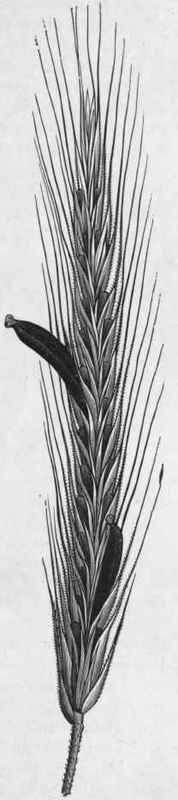
Ergot of rye is a disease in rye plats, caused by the fungus Claviceps pupurea. The fungi appear in the ear of the rye plant as dark brownish, oblong bodies. It used to be so common in rye, that until the 1850s it was believed to be a part of the rye plant. However, quite a while before that, people already knew that ergot was far from innocent. Already in the 1670s, Thuillier, a French physician discovered that ergot of rye was the most likely cause of a disease now known as ergotism.

Image

From the Middle Ages, there are sources describing a common but mysterious disease mostly referred to as ‘holy fire’ or ‘St. Anthony’s fire.’ Symptoms ranged from hallucinations to burning skin and the sensation that insects were wriggling under the skin. Sometimes gangrene of the extremities developed because of constricted blood vessels, and victims could lose hands and feet or their lives. Women with the disease frequently miscarried, and that was in fact the reason that ergot of rye ended up in nineteenth-century medicine chests.

Image

Thullier established the link between ergot of rye and holy fire from the fact that outbreaks mainly occurred in poor rural areas where rye bread was eaten with almost every meal; a food that was not on the tables of rich city dwellers, who ate white bread.  When this became clear, midwives and physicians started to use extracts from ergot of rye in small amounts to induce childbirth in difficult labour, and most likely women tried it as an abortive in the case of an unwanted pregnancy.

That explains why London chemist Richard Reece listed ‘The Ergot of Rye’ in his 1836 catalogue of drugs under the Selection of Medicines for Domestic Use, as a treatment for diseases of the womb and in difficult labour. However, I found the drug in a medicine chest supposedly used by Admiral John Lort Stokes (1812-1885) during his days in the Royal Navy. Now why would a Navy Admiral want bring a drug that seems to have been so particularly gendered? Was it just part of a ready-made medicine chest?

Even if that was the case, it seems unlikely that he would not have taken it and replaced it with some other medicine more useful under the circumstances, as personal space on Navy ships was extremely limited. Another explanation may be that by the time Stokes brought the chest aboard with him, ergot of rye had become a cure for other affections as well – after all, it is still grown today in laboratories to distil particular toxins from it for medicinal purposes. Yet another small mystery to solve!

Sources:

Images from:

Henry G. Greenish,  A Text Book Of Materia Medica, Being An Account Of The More Important Crude Drugs Of Vegetable And Animal Origin.  J. & A. Churchill, 1920

Other sources:

G. Hudler, Magical and Mischievous Molds. Princeton University Press, 2000

M.K. Matossian, Poisons of the Past: Molds, Epidemics and History. Yale University Press, 1998