Understanding jelly as a preservation method: a small-scale reconstruction report
Within the PRESERVARE research project, we use performative methods such as reconstructions to gain a better understanding of our sources and of the past in general. The aim of such reconstructions is not to replicate the past – that is impossible. The goal is to better understand the practices and processes underlying textual descriptions.[1]
For example, I am currently preparing a paper exploring how cane sugar became a widely used product in food conservation technology in the eighteenth century. Previously an expensive commodity mostly used in pharmaceutics and upper-class foods, cane sugar became so widely available in eighteenth-century Europe that it could be used to preserve perishable foods like fruits on a large scale.[2] This also meant that preparations previously only sold by apothecaries, such as jellies, were made by other entrepreneurs, became more widely available, and were used for hedonistic rather than medicinal purposes.
A fascinating example of this process is ‘conserf van vlier,’ elderberry jelly, which, judging by newspaper adverts, became very popular during the last quarter of the eighteenth century in the Northern Netherlands. One such advertisement, put up by an Amsterdam guild barkeeper in 1774, advertises three hundred pounds of elderberry jelly for sale. It mentions that the elderberry jelly has been made after The Amsterdam Apothecary pharmacopeia and has been put into jars in layers, so it can easily be taken out.[3] Large amounts of layered elderberry jelly are advertised by others too in this period, mostly by apothecaries. The layered elderberry jelly was more expensive than the unlayered variety.[4] Yet the 1751 edition of the Amsterdam Apothecary does not mention a ‘conserf van vlier’ (or rob sambuci, in Latin), nor does it offer instructions on how to layer jelly in jars. The only relevant information it contains is a general recipe for rob or jelly that indicates to mix fruit juice with half its weight in powdered sugar, boil until it becomes a gel, and pour the result into jars.[5]
Would it be possible for someone with an entrepreneurial mind and access to The Amsterdam Apothecary to create a layered elderberry jelly in jars at a scale that allows wholesale production? I attempted a small-scale reconstruction in my kitchen. As it was not elder season, I used bottled pure, organic elderberry juice without added sugar. For sugar, I chose organic powdered cane sugar, as this is closest to what would have been used in the eighteenth century. I was skeptical that this would work, as elderberries are relatively low in pectin.[6] Elder juice is however very acidic and astringent, which will help in forming a jelly– I did not test acidity with a pH meter as that is historically irrelevant, but I found the taste mouth-twistingly sour and bitter.
As I used a very small hand-turned, glazed earthenware jar (about 150 ml), I decided to start with 100 ml/101 g of elderberry juice and 50 g of powdered sugar. I first warmed the juice in a stainless-steel saucepan on medium heat (induction cooker). The sugar dissolved instantly, but initially little seemed to happen. After about 5 minutes, the mixture started to bubble violently, and I soon smelled caramel. I turned down the heat and boiled the mixture for another five minutes, constantly stirring with a stainless-steel spoon. When the mixture began to drip off the spoon in threads, I poured it into the jar. The mixture that remained stiffened instantly on the spoon and in the pan. The texture seemed more akin to taffy than jelly to me, but I let it cool and decided to add a second layer another day.
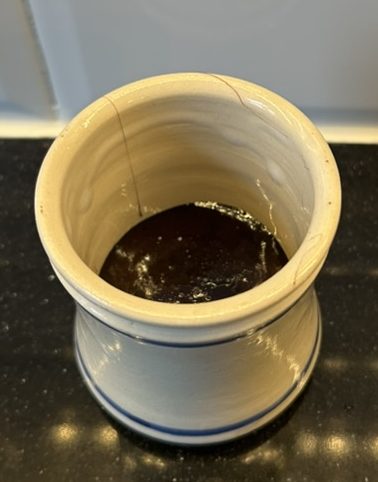
I returned to the rob two days later and created another layer in the same way as the first. I turned down the heat a bit sooner, though, as I did not want the sugar to caramelize. I poured the second layer on top of the first one and cover the jar with a plate. I then left it on the countertop at room temperature for four days.
After four days, I assessed the result. The top layer had not solidified entirely; it was more like very thick syrup, slowly moving to one side when I tilted the jar. Unsurprisingly, I could not lift out the top layer as a whole: I had to spoon it into a dish. It was very sweet but not unpleasant, because the elderberries are so acidic that the jelly still had a tang. Once I had scraped off the top layer, I tried to retrieve the bottom layer from the jar. This was easier said than done: it was rock hard and stuck to the bottom and sides of the jar. Neither a spoon nor a knife allowed me to get it out. I resorted to warming the jar au bain-maire, scooping out most of the jelly, and washing out the jar with boiling water.
Elderberry jelly layered in jars – it sounds so simple. But this small reconstruction shows that it is anything but simple: someone with access to The Amsterdam Apothecary would need experiential and embodied knowledge to produce layered elderberry jelly in jars. It seems likely that the barkeeper advertising this jelly was not the manufacturer of this elderberry jelly, but merely a middleman, running a side business from his bar.
If you want to know more about the rise of sugar as a food preservation technology, see Marieke M.A. Hendriksen, “Luxurious thrift? Sugar as a preservation agent in early modern Dutch food and medicine,” Early Modern Low Countries, forthcoming 2026 (a link will be added once the article has been published).
[1] For a more detailed discussion of the use of performative methods in historical research, see e.g. Hendriksen, Marieke M.A. “Rethinking Performative Methods in the History of Science.” Berichte Zur Wissenschaftsgeschichte 43, no. 3 (2020): 313–22. https://doi.org/10.1002/bewi.202000017.
[2] For the economic, social and political implications of sugar see e.g. Mintz, Sidney W., Sweetness and Power: The Place of Sugar in Modern History. Penguin Books, 1986, and Bosma, Ulbe, The World of Sugar. How the Sweet Stuff Transformed Our Politics, Health, and Environment over 2,000 Years (Cambridge 2023).
[3] Advertentie. “Oprechte Haerlemsche courant”. Haarlem, 27-09-1774, p. 2. Geraadpleegd op Delpher op 12-02-2025, https://resolver.kb.nl/resolve?urn=ddd:010800395:mpeg21:p002
[4] Advertentie. “Oprechte Haerlemsche courant,” Haarlem, 10-09-1789, p. 2. Geraadpleegd op Delpher op 08-01-2026, https://resolver.kb.nl/resolve?urn=ddd:010801531:mpeg21:a0008
[5] Pharmacopoea Amstelredamensis, of Amsteldammer Apotheek, Amsterdam: Gerrit de Groot, 1756, p. 93.
[6] McGee, On Food and Cooking, 296-297.


You must be logged in to post a comment.