The seventeenth-century pharmacy: learning by doing

After focusing on objects and materiality for a bit, this week I returned to the library to read texts. It struck me once again how dense very small pieces of text can be. Part of my new project on metals in Boerhaavian chemistry is getting an idea of how popular and academic medicine worked in practice before Boerhaave. To this end, I am reading late seventeenth-century chemical and pharmaceutical handbooks. From just the two-page foreword of a Dutch 1667 ‘Galenic and Chymical’ pharmaceutical handbook, I could derive the so much about how a seventeenth-century pharmacy functioned, that I want to share it with you.

This handbook is a bit of an exception as it is Dutch, while most chemical and pharmaceutical handbooks of the time were in Latin. But although apothecaries were generally expected to understand Latin, in practice this was not always the case. Unlike today, an apothecary did not need a university degree to practice, and most learned their trade as an apprentice after a couple of years at school. This education system made perfect sense to the author of the handbook, as many of the common ‘compositions’ made by the apothecary were not described in any book: making them was tacit knowledge, not even transferred from master to apprentice orally, but through demonstration and doing.

Title page of the 1657 first edition of the ‘Pharmacia Galenica & Chymica.’

As a sort of supplement to this very practical training, this particular handbook was aimed at young student-apothecaries, and advised them to make sure they learned the Latin names of all the Simplica and herbs (base ingredients) by heart. The author – a Jesuit apothecary – suggests several ways in which this could be achieved: by keeping a list of all the simplica supplied by the druggist and frequently pouring over this, by studying herbaria and other books, by regularly checking the written signs in the apothecary garden, and by looking up the herbs brought in by the ‘herb-fetchers’ (Kruydt-haelders) in books and marking them appropriately after drying.

From this advice, we can deduct a number of other things, like that the apothecary and his apprentice were part of a professional network consisting of at least a druggist and a herb-fetcher. The herb-fetcher is described as getting all the herbs growing in the wild for the apothecary in the cities, and the druggist functioned as a sort of whole-seller of base ingredients for the apothecary. The text also indicates that an apothecary generally had his own herb garden and books, and combined with the fact that he needed to understand at least some Latin, this made the profession a quite respectable one.

We still tend to think of apothecary as a quite respectable profession, but by no means do we think of the apothecary and the alchemist as closely related professions. Yet in the seventeenth century they were: the title page of this handbook reads ‘Galenic & Chymical Pharmacy, That is: Apothecary and Alchymist’ (Pharmacia Galenica & Chymica, Dat is: Apotheker en Alchymiste).


Source: Bisschop, Jan. Pharmacia Galenica & Chymica, Dat Is Apotheker Ende Alchymiste Ofte Distilleer-konste: Begrijpende De Beginselen Ende Fondamenten Der Selver. Verdeylt in Acht Boecken, Tot Onderwijsinge Der Apothekers / Door Een Liefhebber Derselver Konste Nieu Licht Der Apotekers En Distilleerkonst. Antwerpen: Reynier Sleghers, 1667.


The mysteries of mercury

The medicine chest was closed for a week as some moving countries and organising a PhD defence had to be done, but now a new project has been started and it offers endless opportunities for new, fascinating blogs!

As we have seen before, mercury was a hughely popular substance in nineteenth- century drugs, but that popularity already had a long history. In traditional alchemy, mercury was a very important element. Together with sulphur, it was thought to be the origin of all metals, and that through the right processes of distillation and purification of these two, the alchemist would eventually be able to create (philosophical) gold. In line with this, mercury was thought to be a live-giving substance with strong penetrating qualities and thus a useful medicine in ailments that required a thorough purge of the body.

A Chinese emperor even had his tomb filled with rivers of mercury als he thought they might help him find eternal life – ironically, he probably died from taking mercury pills. However, by the seventeenth century it was known that mercury had a dangerous side, and this dual character, together with mercury’s mysterious shimmer and its volatile nature, made it all the more fascinating. Mercury was everywhere until the twentieth century, both in popular and academic chemistry and medicine, as also shows from a late seventeenth-century Dutch book of plates on the crafts, Jan Luyken’s Het Menselijk Bedrijf (‘Man’s activities’) of 1694. In it, a plate is found of a ‘scheider,’ literally a seperator, an alchemist of chemist.

20121027-130736.jpg

With the plate comes a poem: “Ik schei de kwik in twee geslachten; in goede en een kwade, om zich te wachten. In zoet, en in verterend vuur, en dwing haar vluchtige natuur.” This translates as “I seperate mercury in two genders; in good and bad, to make it wait. In sweet, and in digesting fire, and force her volatile nature.” This suggests that it was popular believe that the two characteristics of mercury, the good and the bad, the live-giving and the killing, could be seperated through destillation – and that the remaining residue, that was forced to ‘wait’ was the good part that could be used in medicine.

That mercury was used as a cure-all by virtually anyone who could afford it, is also nicely illustrated by the mummie of Ferdinand II (1467-1496), king of Napels, aka Little Ferdinand. His hair contained the remains of head lice, as well as high concentration of mercury – Ferdinand used it as lice shampoo. In my new research project, I will try to find out exactly how mercury was thought to influence the human body in early eighteenth-century Dutch popular alchemy and academic chemistry, and in these two fields really differed in their ideas.

Medicine chest or kitchen cabinet?

Over the past weeks, some nasty and exotic substances from nineteenth-century medicine chests have been presented. Today however, I am going to focus on some substances that are commonly found in nineteenth-century medicine chests, but that are also still in most kitchens today.

“Spirit of Hartshorn” for example, sounds very mysterious, but is in fact nothing more than an ammonia solution. The Romans called the ammonium chloride deposits they collected in ancient Libya ‘sal ammoniacus’ (salt of Amun) because of proximity to the nearby temple of Amun or Ammon. Before the mid-nineteenth century, this compound of nitrogen and hydrogen (NH3) was usually made from horn shavings, hence the name ‘spirit of hartshorn.’ We now keep its chemically manufactured equivalent in our cleaning cupboards. In medicine chests the substance can be found under various names, such as Liq. Ammon Fort., and it was used to treat stings and insect bites, as it reduces pain an irritation of the skin.

You’d be surprised what you can do with spices…


Other substances that are very common in nineteenth-century medicine chests are all kinds of spices and plant extracts, such as ground ginger, rhubarb powder, and clove oil. Most of these were introduced in Europe in the sixteenth century, when explorers and traders brought them back from newly discovered regions. Rhubarb however was indigenous, although in the nineteenth century medical handbooks sometimes distinguished between various geographical origins, i.e. Turkish and European rhubarb. Savory, a chemist, stated that rhubarb was “…an excellent remedy in case of flatulent affection of the bowels attended with griping pains, and in diarrhoea free from inflammation; but it should not be indiscriminately administered in every case of pain in the bowels, on account of the stimulating nature of the spirit with which it is prepared.” [1]

Ginger, either dried and powdered or in the form of an essence, was advised in all kinds of ailments, but particularly in cholic and gout. It was thought to be warming, and with a more lasting effect than other spices.[2] Rhubarb and ginger were also often combined, most famously in Gregory’s Powder. This mixture of rhubarb, ginger and magnesium carbonate was one of the most common self-prescription medicines for over a hundred and fifty years after it had been developed by James Gregory (1752-1821), a professor of physic in Edinburgh.[3]

In the Dublin Literary Gazette in 1830, we find an advertisement for  “DR. GREGORY’S STOMACHIC POWDER of Rhubarb, Ginger, and Calcined Magnesia, for Indigestion, Flatulence, Acidity, &e.”

Clove oil may not be in your spice rack, but cloves, whole or powdered, probably are – and even today sucking on a clove may alleviate a toothache, albeit temporarily. Clove oil can also still be purchased in pharmacies without a prescription. This is because the active ingredient, eugenol, is a natural analgaesic and antiseptic. For that reason, clove oil is found in so many medicine chests from the nineteenth century, especially in chests that were assembled for travellers. They could easily find themselves many days away from a dentist, and then clove oil was their first resort. All this shows that while many nineteenth-century drugs were ineffective or even harmful, some were innocent and even quite useful.


[1] Savory, A companion to the medicine chest, 1836, p. 92

[2] Bond’s Companion to the Medicine Chest, ca. 1862 p. 25

Quinine in the Arctic

Quinine – most of us have heard of it and associate it with the treatment of malaria. Recently a certain manufacturer of soft drinks even mentioned it again in a sort of mock-colonial advert for tonic water. Although tonic water was indeed originally mixed as an anti-malaria treatment in tropical regions, what the ad does not mention is that our tonic water contains less than 20 milligrams of quinine per 1.5 decilitre, whereas the recommended quinine dosage for treatment of malaria is two or three 200-350 milligram tablets three times a day.[1]

In several of the medicine chests at the National Maritime Museum, preparations of quinine are also found, including quinine disulphate in a chest that was used by the ill-fated Franklin expedition to the Arctic (1845).[2] Searching for a North-western passage to Asia, all 128 men died after their boats got stuck in the ice in the Canadian Arctic.[3] Seen through twenty-first century eyes, it may seem very odd to take anti-malaria drugs on an Arctic expedition. Upon closer investigation, it is not as strange as it seems.

A nineteenth-century bottle of a quinine preparations, like the one in the chest of the Franklin expedition.

Quinine, an alkaloid made of the bitter red bark of the cinchona tree, was ‘discovered’ in Peru in 1631. It was no chance discovery – the Quechua already knew it, but malaria was not indigenous to the new world. In fact, the discovery of the usefulness of quinine in malaria by a Jesuit apothecary was the result of  a search commanded by Pope Urban VIII, after ten cardinals and hundreds of their attendants who came to Rome to elect a new pope died in the Roman marshes in 1623 from ‘bad air’ or, in Italian, mal’aria.[4]

Unlike what many people think nowadays, malaria is not unique to tropical regions. Until the early twentieth century, it was indigenous to much of Europe. Epidemics regularly occurred in regions as northern as Denmark and even Finland.[5] Moreover, the malaria parasite was not discovered until 1880 by the French army surgeon Charles Louis Alphonse Laveran (who received a Nobel prize for his discovery in 1907).[6] So until 1880, malaria was literally mal’aria: a disease characterized by intermittent fevers, thought to be caused by ‘bad air.’

Obviously, this ‘bad air’ could occur anywhere, so it made perfect sense to the men on Franklin’s expedition to take it with them on their Arctic explorations. There is a fair chance they too mixed it with other beverages though, as the quinine disulphate they brought with them tasted so bitter that it induced vomiting before it could have any therapeutic effect…

Image source: http://carmichael.lib.virginia.edu/story/pharmacy.html


[2] Catalogue numbers AAA2224.18, TOA0131.4

[3] John Geiger and Owen Beattie, Frozen in Time: The Fate of the Franklin Expedition. Bloomsbury Publishing PLC, 2004

[4] Fiammetta Rocco, The Miraculous Fever-Tree: Malaria, Medicine and the Cure that Changed the World. HarperCollins 2010

[5] Reiter, Paul. “Global warming and malaria: knowing the horse before hitching the cart”. Malaria Journal 7 (2008): suppl. 1.

Hidden opiates and mercury

About two weeks ago, I had coffee with the head of the conservation department of the National Maritime Museum. She asked me if I could mark the bottles and containers from the medicine chests in the database that had potentially hazardous substances in them. As I compiled a list of all the substances and their contemporary uses for my research project anyway, I promised her to do so.

Obviously, many of the substances in the chest can be hazardous if you would swallow an entire bottle at once, but the conservation department is particularly interested in substances that are either a health risk if not properly stored, such as mercury, and substances that are subject to legal regulations, such as opiates. Even if the opium is over a century old, you still need a license to keep it! And as a matter of fact, there are quite some hidden opiates and mercury in the medicine chests.

Some of them are quite easy to recognise, because their label reads something like ‘Hydr.’ (hydrargyrum; mercury), or ‘compound powder of chalk with opium’, and anyone who has ever read a Victorian novel will know laudanum should not be spoon-fed to infants – although one can imagine it would make them very calm. However, others are less straightforward. Grey powder, blue pills, Dover’s powder, paregoric elixir, and calomel or calamel all contain mercury or opium.

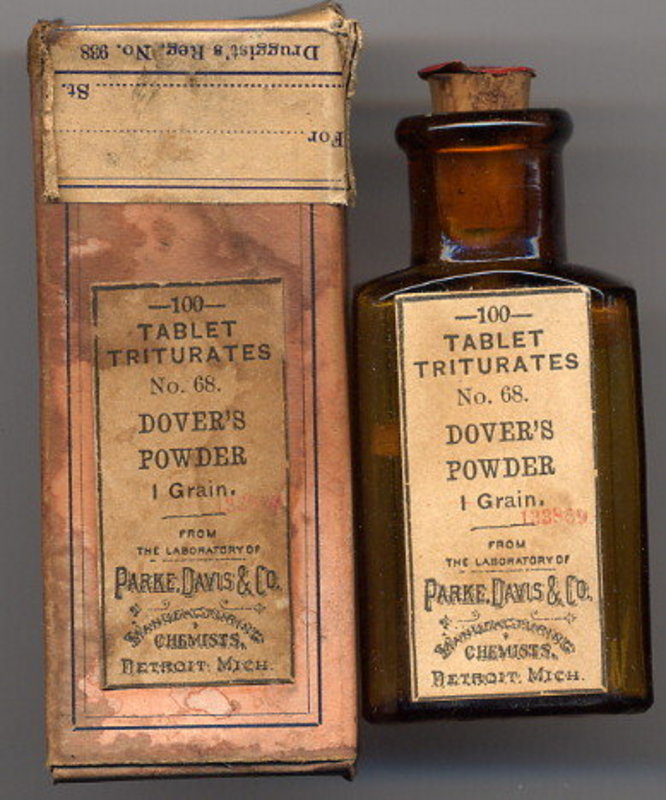
Dover’s powder for example, was a traditional medicine against cold and fever developed by Thomas Dover (1660–1742), aka Doctor Quicksilver. Its’ recipe i  Encyclopaedia Britannica: Or a Dictionary of Arts, Sciences and Miscellaneous Litterature of 1810 says:

“Sudorific, or Dover’s powder. E. Take of vitriolated tartar, three drams; opium, root of ipecacuanha powdered, of each one scruple. Mix, and grind them accurately together, so as to make an uniform powder.”

A late nineteenth century bottle of Dover’s Powder – advertised as fever medicine.

But Dover was certainly not the only or the last physician to subscribe mercury-based drugs to his patients. Medication with mercury as the active ingredient was used in the treatment of venereal and skin diseases up to the early twentieth century, and in the nineteenth century they could be found in both traveller’s and family medicine chests in abundance. Turnbull in his 1806 book The Naval Surgeon writes that John Clark  in 1773 was the first to use calomel (mercury chloride) in dysentery in ‘hot countries’.

John Savory, in his 1836 A Companion to the Medicine Chest wrote of calomel: “This mercurial preparation is more extensively and more usefully employed than almost any other article of the Materia Medica. But its principal use is as a purge, conjoined with other aperients; and for this purpose it is administered in doses of from three to six grains, combined with, or followed by, cathartic extract, rhubarb, senna, or other laxatives. (…) In affections of the liver, in various glandular diseases, and in some cutaneous eruptions, calomel is celebrated as an alternative; and, combined with diuretics, it singularly contributes to their activity. (…)..,and in croup no remedy proves so decidedly useful as calomel, in these combinations, administered after bleeding and purging.(…)”

These prescriptions make you wonder to what extent mercury poisoning influenced nineteenth-century society, as it acts as a neurotoxin in the human body, and interferes with the brain and nervous system. In children, it may affect development and cause learning disabilities; in adults it can affect fertility and memory, cause tremors, loss of vision and in severe cases lead to death…

For more on Thomas Dover and quicksilver doctors, see Swiderski, Richard M. Quicksilver : A History of the Use, Lore and Effects of Mercury. Jefferson, NC: McFarland, 2008.

Strong medicine

This week, I worked on a list of all the substances that can be identified in the medicine chests at the National Maritime Museum. I am hoping that the drugs found in the chests will tell something more about when, how and by whom they were used. All in all, there are approximately seventy different kinds of materia medica on the list now. Some are very familiar, like aspirin, olive oil, powdered ginger and magnesium. Others have been banned as medicines for some time, and for good reason: mercury pills, laudanum and opium tincture for example. And some are downright creepy at first sight, like ergot of rye.

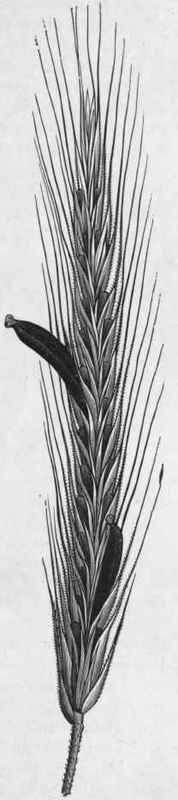
Ergot of rye is a disease in rye plats, caused by the fungus Claviceps pupurea. The fungi appear in the ear of the rye plant as dark brownish, oblong bodies. It used to be so common in rye, that until the 1850s it was believed to be a part of the rye plant. However, quite a while before that, people already knew that ergot was far from innocent. Already in the 1670s, Thuillier, a French physician discovered that ergot of rye was the most likely cause of a disease now known as ergotism.

Image

From the Middle Ages, there are sources describing a common but mysterious disease mostly referred to as ‘holy fire’ or ‘St. Anthony’s fire.’ Symptoms ranged from hallucinations to burning skin and the sensation that insects were wriggling under the skin. Sometimes gangrene of the extremities developed because of constricted blood vessels, and victims could lose hands and feet or their lives. Women with the disease frequently miscarried, and that was in fact the reason that ergot of rye ended up in nineteenth-century medicine chests.

Image

Thullier established the link between ergot of rye and holy fire from the fact that outbreaks mainly occurred in poor rural areas where rye bread was eaten with almost every meal; a food that was not on the tables of rich city dwellers, who ate white bread.  When this became clear, midwives and physicians started to use extracts from ergot of rye in small amounts to induce childbirth in difficult labour, and most likely women tried it as an abortive in the case of an unwanted pregnancy.

That explains why London chemist Richard Reece listed ‘The Ergot of Rye’ in his 1836 catalogue of drugs under the Selection of Medicines for Domestic Use, as a treatment for diseases of the womb and in difficult labour. However, I found the drug in a medicine chest supposedly used by Admiral John Lort Stokes (1812-1885) during his days in the Royal Navy. Now why would a Navy Admiral want bring a drug that seems to have been so particularly gendered? Was it just part of a ready-made medicine chest?

Even if that was the case, it seems unlikely that he would not have taken it and replaced it with some other medicine more useful under the circumstances, as personal space on Navy ships was extremely limited. Another explanation may be that by the time Stokes brought the chest aboard with him, ergot of rye had become a cure for other affections as well – after all, it is still grown today in laboratories to distil particular toxins from it for medicinal purposes. Yet another small mystery to solve!

Sources:

Images from:

Henry G. Greenish,  A Text Book Of Materia Medica, Being An Account Of The More Important Crude Drugs Of Vegetable And Animal Origin.  J. & A. Churchill, 1920

Other sources:

G. Hudler, Magical and Mischievous Molds. Princeton University Press, 2000

M.K. Matossian, Poisons of the Past: Molds, Epidemics and History. Yale University Press, 1998

Not all is what it seems…

On Monday I started work at the National Maritime Museum. So far it has been wonderful – everyone is very welcoming and interested in the project, and working in such a historically laden place is absolutely great. This Wednesday was the most exciting day of the week, as I was allowed to spend all day in a storage room with the medicine chests to study them. The first thing that struck me was their size or rather lack thereof. The measurements are in the catalogue, so I already knew the chests were not that big, yet seeing something with your own eyes is of course still an entirely different experience.

These medicine chests upon closer inspection looked like very practical first-aid kits, each containing about twenty to forty different material medica. Then something struck me: before coming to London I had been reading up on eighteenth- and nineteenth century English Navy medicine, and the lists of prescribed contents of ship’s surgeons’ chests I had seen seemed far more extensive than the contents of these chests. So I checked again, and indeed, in 1806 the standard Navy medicine chest contained about 62 different substances.

Does that mean the medicine chests at the NMM are not ship’s surgeons’ chests at all? It is possible, even if they were most likely used on ships. Most of them are simply too small to sustain a substantial ship’s crew with medical care for months or even years, and contain only drugs that can also be found in popular ‘companions to the medicine chest’ from the same  period. Yet it is not so strange that someone boarding a ship, naval, merchant or exploratory, would invest in a personal medicine chest if he could afford it. Even if there was a surgeon aboard, there was a fair chance he would also fall ill and die at some point, and then it was most practical to have your own first-aid kit with you.

Moreover, ship’s surgeons seem to have constantly complained about being underpaid, which may have led them to use the drug supplies otherwise, and some of them were very inexperienced. All the more reason to bring your own stash. Meanwhile, I have already found some exciting leads in the archives on where these chests might be from and how they were used… to be continued!

PS: My initial plan this week was to write about the strange ceramics in huge Erlenmeyer flasks resembling wet anatomical preparations that I saw at the Naturmuseum Winterthur, but as I could not get into touch with the curator to ask who made them and how they were intended. I am still working on it, so maybe in a later blog!

Must objects have meaning?

This week, I was in Winterthur, Switzerland. Lina Gafner and Siegfried Bodenmann of Universität Bern kindly invited me to present a paper at a workshop for young researchers sponsored by the Schweizerischen Gesellschaft für die Geschichte der Medizin und der Naturwissenschaften (SGGMN). The workshop was titled Objekte der Wissenschaft, Wissenschaft der Objekte, which roughly translates as Objects of Science, Science of Objects.*

My paper was based on one of my thesis chapters; the one about the bead-decorated preparations of human foetuses in the Leiden anatomical collections. I am not going to elaborate on this specific topic now, as my thesis will hopefully get attention elsewhere once I have defended it. What I want to share with you today is what we discussed at the workshop. It might seem a bit abstract (I know, strange as it is supposed to be about concrete objects) to those not in the field, but I find it so interesting I’ll take the risk of sharing. J

During the workshop, all kinds of objects starred in the papers: the white doctor’s coat, Indonesian keris daggars, seventeenth-century herbal guides, barometers, brain scans, models used in biology classes, even radiation, and of course the Leiden preparations. In the closing discussion, we saw that although we say that we write the history of things, what actually happens is that the materiality of objects is a way to access their meanings (which can change over time) and their reception history. This, to me, confirmed what I have thought for a while now, namely that although objects do have agency –  they can influence what happens in a network of things and people – but that that agency is of a different nature than that of human actors.

Another interesting issue we encountered was what happens with things that have lost their previous meanings, i.e. because they have been taken out of their original context and the new network they are part of does not remember and cannot (or will not) retrieve the original context. For example, the Indonesian keris one participant told us about had all kinds of magical, social and ritual meanings in certain parts of Indonesian society, but are now mere decorative exotic objects in some Western households. Of course, they may gain new meanings there; for the family who brought it with them from vacation it may be a beloved souvenir. But is that really a meaning?

Kant would say that if you appreciate das Ding an sich, without caring where it comes from, who made it, or what purpose it might serve, that is the essential disinterested aesthetic experience. Fair enough, but in the case of objects we historians of science know or suspect to have had a meaning in the past, like instruments and preparations, this seems unsatisfactory: we want to know why the thing was made, how it functioned originally, influenced the people around it throughout time. We feel we have to in order to do these objects justice, and to answer questions regarding their preservation and display in a museum setting.

Next week I’ll write about something more concrete: something peculiar that I saw at the workshop location, the Naturmuseum in Winterthur.

*Here the annoying problem returns that in German and Dutch Wissenschaft/wetenschap can also include the humanities, whereas in English they are more or less excluded by the use of the word ‘science’.

Treasure troves

Next week, I am leaving for London again. I’ve spent time in the big smoke before, first as a graduate student in 2006-2007, when I took the London Consortium’s MRes programme. In 2011, I spent three months as a research associate at the  Wellcome Trust Centre for the History of Medicine at UCL for my PhD. This time, I have won a research intern grant at the National Maritime Museum at Greenwich. So back to my old stomping grounds – although Greenwich feels very different from Bloomsbury. It’s a town in it’s own right. But enough for the memories now: I am going to the NMM to dig out some treasure troves.

Because that’s what the nine ship’s surgeons’ medicine chests from between 1750 and 1850 kept in the collections are to me. Of a few, we know that they were the possession of famous lieutenants or explorers; of others we know next to nothing. Looking at the beautiful photos on the NMM website, I wonder why they all look so different. Were they made to order, and do the make-up and fittings tell something about the status and preferences of the owner? Or were it navy superiors and expedition sponsors who decided what the chests looked like and contained? And what was in those stoppered bottles? The usual suspects, or materia medica especially chosen for the ailments common to battle or tropical climates? And if the ship’s surgeon found some indigenous cure in a faraway region, did he add it to his chest?

It is questions like these that I am going to try to answer in the five weeks I will spend at the NMM. And I already made a small start, reading up on British navy and colonial medicine in the period. I also checked whether there were any interesting documents relating to the NMM medicine chests in Dutch archives. At the University of Amsterdam Library Special Collections, I found a letter written by William Edward Parry (1790-1855), Arctic explorer, the owner of one of the medicine chests, in 1823, to his friend John Barrow (1764-1848).* Barrow was a statesman and explorer with a lifelong interest in the Arctic, but he also travelled the Cape of Good Hope extensively. You never know if there’s anything relevant to your project in such a document, so of I went.

Parry and Barrow, like many learned men of their time, shared an interest in collecting naturalia, as also shows from the letter in Amsterdam. Parry wrote the letter while recovering from an illness, and mainly discussed news from friends and family. In the P.S. however, he’s talking business again. Here he wrote:

“The key of the [Ferry’s] mineral chest is in my possession. I will send by the first opportunity. I trust the minerals & other specimens will not be plundered before they are described. I have reason to know that they were so on the last occasion, which induces me to mention it now.”

The underlining is in the original, so even though Barrow was a good 25 years his senior, Parry makes it clear he is not one to be messed with. There was nothing about medicine chests in this letter, but it is an indication of the kind of man Parry was – I can’t wait to find out more about him and his medicine chest!

*Call number: UB: HSS-mag.: TOA hs. 128 Ar 1-2